#3 Focus & Concentration3. Deep Work — Cal Newport
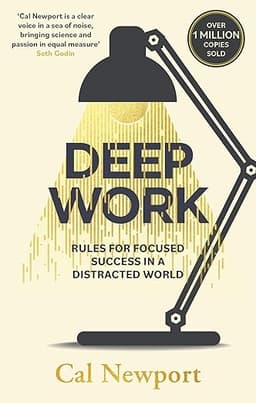
Best for: Protecting uninterrupted concentration and building valuable cognitive skills
What the book is about: Computer science professor Cal Newport defines "Deep Work" as professional activities performed in a state of distraction-free concentration that push your cognitive capabilities to their limit. Newport argues that deep work is becoming increasingly rare just as it is becoming increasingly valuable in our economy.
What makes it interesting: Newport explains "attention residue"—how checking email for even 5 seconds leaves cognitive residue that degrades your focus for up to 20 minutes afterward.
What You'll Actually Gain:- Schedule 90-minute distraction-free blocks
- Quit network tools that fragment attention
- Embrace boredom to train brain focus
Real-Life Scenario:A freelance writer blocks out 8:00 AM–10:30 AM every morning with Wi-Fi disabled, producing double the output in half the hours.
Read this if: Your workday is constantly interrupted by Slack, email, notifications, and task-switching.
Skip this if: Your job requires real-time phone availability, such as emergency customer support.
Verdict: The absolute best book for focus, depth, and cognitive productivity.
Books 6–15: Specialized Problem Solvers
6. Eat That Frog! — Brian Tracy
ProcrastinationBest for: Tackling your biggest, hardest task first thing in the morning.
Key Takeaway: Your "frog" is your highest-impact task—the one you are most likely to procrastinate on. Eating it first guarantees daily progress before energy declines.
7. Feel-Good Productivity — Ali Abdaal
Sustainable EnergyBest for: Achieving goals through enjoyment, play, and energy management without burnout.
Key Takeaway: Success doesn't lead to happiness; feel-good emotions fuel productivity. Focus on play, power, and friction reduction.
8. Digital Minimalism — Cal Newport
Digital DistractionBest for: Conducting a 30-day digital declutter and reclaiming your attention from apps.
Key Takeaway: Rebuild your relationship with technology from scratch, using tools intentionally for high-value pursuits only.
9. The One Thing — Gary Keller & Jay Papasan
Singular GoalBest for: Identifying the single most important lever that makes everything else easier.
Key Takeaway: Ask the Focusing Question: "What's the ONE Thing I can do such that by doing it everything else will be easier or unnecessary?"
10. The 7 Habits of Highly Effective People — Stephen R. Covey
Character LeadershipBest for: Principle-centered leadership, personal vision, and long-term character building.
Key Takeaway: Shift from dependence to independence (Be Proactive, Begin with the End in Mind, Put First Things First) to interdependence.
11. Ultralearning — Scott Young
Rapid LearningBest for: Master complex skills quickly through self-directed, intense learning projects.
Key Takeaway: Use directness, drills, active recall retrieval, and immediate feedback loops to accelerate skill acquisition.
12. The Compound Effect — Darren Hardy
Daily MomentumBest for: Understanding how small daily choices compound into massive long-term success.
Key Takeaway: Consistency is the ultimate key. Small smart choices + consistency + time = radical difference.
13. How to Change — Katy Milkman
Behavioral ScienceBest for: Scientific strategies for overcoming procrastination, forgetfulness, and laziness.
Key Takeaway: Match your strategy to your specific internal obstacle (e.g. use the Fresh Start Effect for motivation dips).
14. The Power of Habit — Charles Duhigg
Habit PsychologyBest for: Understanding the Golden Rule of habit transformation and corporate habit loops.
Key Takeaway: You cannot extinguish a bad habit; you can only transform it by keeping the cue and reward while replacing the routine.
15. Rework — Jason Fried & David Heinemeier Hansson
Workplace EfficiencyBest for: Cutting corporate fluff, useless meetings, and fake work.
Key Takeaway: Workaholism is stupid. Focus on executing quickly, launching simple products, and cutting unnecessary meetings.