

Atomic Habits in 2 Minutes
Atomic Habits by James Clear teaches that major personal transformations don’t come from radical shifts, but from the compounding power of small 1% daily improvements. Over a year, getting 1% better every day results in a 37x improvement.
The book’s core thesis is that you do not rise to the level of your goals; you fall to the level of your systems. Sustainable change begins by focusing on who you want to become (identity) rather than just what you want to achieve (outcomes). Every small habit you perform acts as a vote for your desired identity.
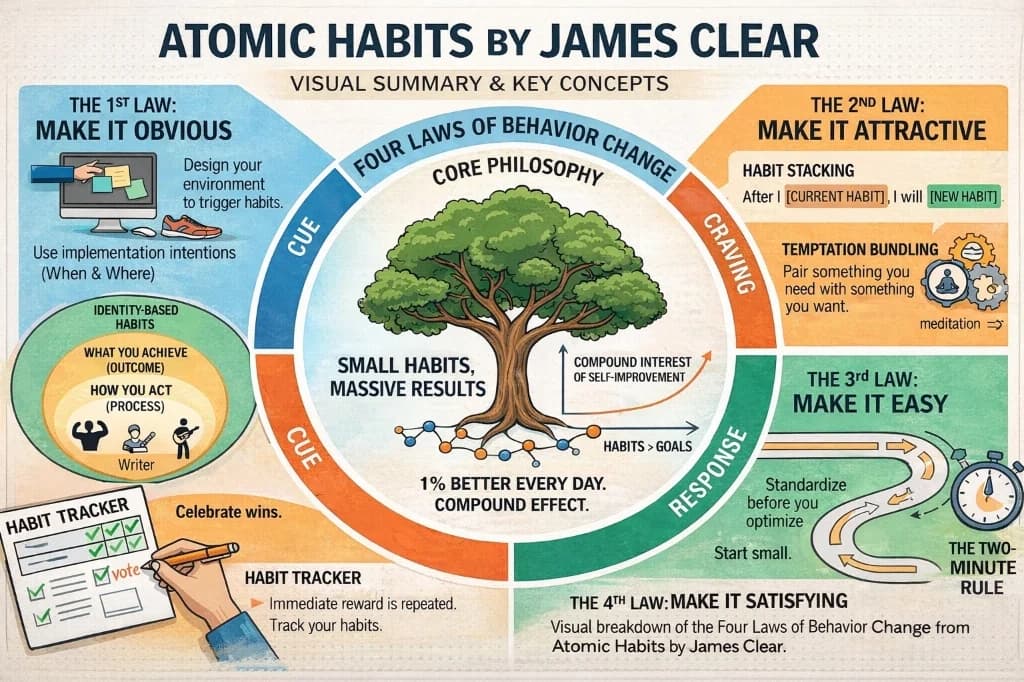
To build consistent habits, Clear provides the 4 Laws of Behavior Change:
By designing your environment, using the Two-Minute Rule to master showing up, and tracking progress with a "Never Miss Twice" mindset, good habits become effortless and permanent.
Atomic Habits Chapter-by-Chapter Summary
Below is a complete, chapter-by-chapter breakdown of all 20 chapters in Atomic Habits. Each section summarizes the core lesson, translates it into simple language, provides a concrete example, and links to the full chapter guide.
Chapter 1 — The Surprising Power of Atomic Habits
Simple Summary:
Clear explains that small 1% daily improvements compound over time into massive long-term results. Getting 1% better every day yields a 37x improvement after a year, while getting 1% worse reduces your progress to near zero. Most people get discouraged because results lag behind effort, creating what Clear calls the "Plateau of Latent Potential." The key is focusing on systems rather than goals.
In Simple Words:
Don’t worry about hitting massive goals overnight. Focus on tiny daily routines instead. Your current habits predict where you will end up in 5 years.
Real Example:
A pilot adjusting an airplane’s nose by 3.5 degrees departing Los Angeles lands in Washington D.C. instead of New York. Micro-shifts dictate your ultimate destination.
Key Takeaway:
You do not rise to the level of your goals; you fall to the level of your systems.
Chapter 2 — How Your Habits Shape Your Identity (and Vice Versa)
Simple Summary:
Lasting behavior change happens from the inside out. Clear introduces the three layers of behavior change: Outcomes (what you get), Processes (what you do), and Identity (what you believe). Most people try to change habits by setting outcome goals. Clear argues you should start with identity—deciding who you want to become—and prove it through small wins ("votes" for your new self-image).
In Simple Words:
Instead of saying "I want to read 20 books," say "I am a reader." Every small action you take is a vote for the person you want to be.
Real Example:
When offered a cigarette, Person A says "No thanks, I’m trying to quit." Person B says "No thanks, I’m not a smoker." Person B has shifted their identity.
Key Takeaway:
True behavior change is identity change; every action is a vote for who you wish to become.
Chapter 3 — How to Build Better Habits in 4 Simple Steps
Simple Summary:
This chapter details the neurobiological feedback loop underlying all human behavior: Cue, Craving, Response, and Reward. The cue triggers a brain prediction, the craving is the motivational drive to change state, the response is the action taken, and the reward satisfies the craving and reinforces the memory. From this 4-step loop, Clear derives the 4 Laws of Behavior Change.
In Simple Words:
Your brain runs on a 4-part loop: see a signal, feel a desire, take an action, get a reward. To build a good habit, make the signal obvious, the desire attractive, the action easy, and the reward satisfying.
Real Example:
Hearing your phone buzz (cue) creates curiosity to check messages (craving). You grab the phone (response) and feel relief or connection (reward).
Key Takeaway:
Cues trigger cravings, responses deliver rewards, and rewards teach your brain which habits to repeat.
Chapter 4 — The Man Who Didn't Look Right
Simple Summary:
Clear explains that habits become automatic through non-conscious mental processing. Before you can change a habit, you must become conscious of it. He introduces the Habit Scorecard—a tracking method where you list daily behaviors and mark them as positive (+), negative (-), or neutral (=). He also highlights Pointing-and-Calling, a safety technique that raises awareness of automatic actions.
In Simple Words:
You can’t fix a bad habit if you don’t notice you’re doing it. Say your habits out loud or write them down to wake up your conscious mind.
Real Example:
A Japanese train conductor points at a green signal and speaks "Signal is green!" out loud to prevent automatic autopilot mistakes.
Key Takeaway:
Until you make the unconscious conscious, it will direct your life and you will call it fate.
Chapter 5 — The Best Way to Start a New Habit
Simple Summary:
This chapter introduces two explicit scheduling techniques: Implementation Intentions and Habit Stacking. Research shows people are twice as likely to follow through when they specify the exact time and location of a new habit: "I will [BEHAVIOR] at [TIME] in [LOCATION]." Habit stacking pairs a new behavior with an existing anchor: "After [CURRENT HABIT], I will [NEW HABIT]."
In Simple Words:
Vague goals fail. Tell your brain exactly when and where you will act, or stack your new habit onto something you already do every single day.
Real Example:
"After I pour my morning coffee, I will meditate for one minute at the kitchen counter."
Key Takeaway:
Give your habits a time and space to live in the world through implementation intentions and habit stacking.
Chapter 6 — Motivation Is Overrated; Environment Often Matters More
Simple Summary:
Clear challenges the idea that willpower drives behavior, arguing that environment is the invisible hand shaping human choice. We naturally choose products and actions based on visual availability. By redesigning your physical environment—making visual cues for good habits prominent and cues for bad habits invisible—you reduce reliance on self-control.
In Simple Words:
Environment matters more than willpower. Put water bottles on your desk if you want to drink more water; put apples on the counter instead of cookies.
Real Example:
Dr. Anne Thorndike reorganized a hospital cafeteria by placing bottled water in every cooler alongside soda. Water sales surged by 25.8% without a single word of persuasion.
Key Takeaway:
Be the architect of your environment, not merely the consumer of it.
Chapter 7 — The Secret to Self-Control
Simple Summary:
Clear reveals that disciplined people aren’t superhuman—they simply structure their lives so they face fewer temptations. Self-control is a short-term strategy, not a long-term habit engine. Once a habit is encoded, the urge persists whenever the cue appears. To break a bad habit, invert the 1st Law: Make It Invisible by removing the cue entirely.
In Simple Words:
Don’t try to fight temptation all day. Remove the temptation from your sight so you don’t need willpower in the first place.
Real Example:
If you get distracted by your phone while working, leave your phone in another room until lunch.
Key Takeaway:
You can win a battle with temptation, but the easiest way to win is to avoid the battle altogether.
Chapter 8 — How to Make a Habit Irresistible
Simple Summary:
Covering the 2nd Law of Behavior Change (Make It Attractive), Clear explains how dopamine spikes drive craving and anticipation. It is the anticipation of a reward—not the fulfillment itself—that triggers action. He introduces Temptation Bundling, which pairs an action you need to do with an action you want to do.
In Simple Words:
Make your habit tempting by linking it to something you already enjoy. Dopamine surges when you look forward to a reward.
Real Example:
An engineering student programmed an exercise bike to only unlock Netflix streaming when he pedaled above a certain speed.
Key Takeaway:
Desire is the engine that drives behavior; bundle what you need with what you want to make habits irresistible.
Chapter 9 — The Role of Family and Friends in Shaping Your Habits
Simple Summary:
Humans are social animals who adapt their behavior to fit three social groups: The Close (family and friends), The Many (the tribe or culture), and The Powerful (those with high status). Clear explains that joining a culture where your desired behavior is normal—and where you already have something in common with the group—is one of the most effective ways to sustain habits.
In Simple Words:
You adopt the habits of the people around you. Join groups where doing your target habit is the normal everyday behavior.
Real Example:
The Polgár sisters became chess prodigies because their parents built a home culture where chess was the central, praised family activity.
Key Takeaway:
Join a culture where your desired behavior is the normal behavior, and you will adapt naturally.
Chapter 10 — How to Find and Fix the Causes of Your Bad Habits
Simple Summary:
Bad habits are modern solutions to ancient evolutionary desires (e.g., scrolling social media satisfies the desire for social connection). Clear explains that cravings are emotional predictions about how a state change will feel. To break a bad habit, invert the 2nd Law: Make It Unattractive by reframing your mindset to highlight the heavy costs of the bad habit.
In Simple Words:
Reframe how you think about bad habits. Instead of thinking "I am sacrificing something," realize what you gain by giving it up.
Real Example:
Instead of saying "I have to go to work," shift your language to "I get to go to work and build my skills."
Key Takeaway:
Reframing your mindset from "have to" to "get to" highlights benefits and makes bad habits unattractive.
Chapter 11 — Walk Slowly, but Never Backward
Simple Summary:
Clear distinguishes between being in Motion (planning, researching, strategizing) and taking Action (executing a behavior that yields a result). People stay in motion because it feels like work without the risk of failure. To build a habit, you must practice repetition. Long-term habit formation is dictated by frequency of repetition, not the passage of calendar time.
In Simple Words:
Planning isn’t the same as doing. Stop researching the perfect workout and just do 10 pushups. Repetition builds neural pathways.
Real Example:
A photography professor divided his class into two groups: one graded on the quantity of photos produced, the other on a single "perfect" photo. The quantity group produced the best photos through trial and error.
Key Takeaway:
Action beats motion every time; focus on repeating the habit rather than perfecting the plan.
Chapter 12 — The Law of Least Effort
Simple Summary:
Clear explains the 3rd Law of Behavior Change (Make It Easy). Human behavior naturally follows the Law of Least Effort: we choose the option that requires the least energy. To build good habits, reduce friction between you and the action. To break bad habits, increase friction until the action becomes inconvenient.
In Simple Words:
Make good choices effortless and bad choices frustrating. Prepare your gear the night before so starting takes zero friction.
Real Example:
A Japanese manufacturer redesigned factory floors so tools were placed within arm’s reach of workers, eliminating wasted movements.
Key Takeaway:
Reduce friction to make good habits effortless; increase friction to make bad habits impossible.
Chapter 13 — How to Stop Procrastinating by Using the Two-Minute Rule
Simple Summary:
Even when you know a habit is good, starting feels daunting. Clear introduces the Two-Minute Rule: "When you start a new habit, it should take less than two minutes to do." Instead of trying to read 50 pages, read 1 page. The goal is to master the art of showing up before optimizing. A habit must be established before it can be improved.
In Simple Words:
Downscale your habit until it takes under 2 minutes. You can’t optimize a habit that doesn’t exist yet.
Real Example:
Instead of "run 3 miles," the habit is "put on my running shoes and walk out the front door."
Key Takeaway:
Master the art of showing up first; scale down new habits until they take under two minutes.
Chapter 14 — How to Make Good Habits Inevitable and Bad Habits Impossible
Simple Summary:
To lock in good behaviors, Clear recommends using Commitment Devices—choices made in the present that lock in better behavior in the future. He also highlights automation (one-time decisions like automatic savings transfers or app blockers) that permanently enforce positive behavior or eliminate bad options.
In Simple Words:
Lock your future self into good choices. Use tools, lockboxes, or automatic payments so you can’t back out when motivation fades.
Real Example:
Writer Victor Hugo asked his valet to lock all his clothes away so he couldn’t leave his house, forcing himself to stay inside and complete his novel.
Key Takeaway:
Use commitment devices and single one-time automations to guarantee your future actions.
Chapter 15 — The Cardinal Rule of Behavior Change
Simple Summary:
Introducing the 4th Law of Behavior Change (Make It Satisfying), Clear presents the Cardinal Rule: "What is immediately rewarded is repeated. What is immediately punished is avoided." Humans evolved in an Immediate-Return Environment, but modern society operates in a Delayed-Return Environment. To make a habit stick, add an immediate token of gratification right after completing it.
In Simple Words:
Your brain loves instant rewards. Give yourself a quick, satisfying win immediately after doing a good habit.
Real Example:
A couple opened a savings account labeled "Trip to Europe." Every time they passed on eating out, they transferred $50 into the account, creating instant satisfaction.
Key Takeaway:
What is immediately rewarded is repeated; add immediate satisfaction to reinforce good routines.
Chapter 16 — How to Stick with Good Habits Every Day
Simple Summary:
Clear emphasizes the power of tracking progress visually. A Habit Tracker (like marking an X on a calendar) provides visual proof of your progress, which is inherently satisfying. He warns against breaking the chain and establishes the fundamental rule for long-term consistency: "Never Miss Twice." Slips are inevitable, but missing once is an accident; missing twice is the start of a new bad habit.
In Simple Words:
Track your habit on a calendar. If you miss one day due to an emergency, bounce back immediately the very next day.
Real Example:
Bank salesman Trent Dyrsmidth moved a paperclip from one jar to another every time he made a sales call, keeping his daily output visual and rewarding.
Key Takeaway:
Never miss twice; one setback is a slip, but two in a row is the start of a new habit.
Chapter 17 — How an Accountability Partner Can Change Everything
Simple Summary:
Just as immediate rewards reinforce habits, immediate costs eliminate bad ones. Clear explains how to invert the 4th Law: Make It Ununsatisfying. He introduces the Habit Contract—a written agreement specifying clear consequences if you fail to perform a habit. Social stakes and public accountability create immediate friction against slipping up.
In Simple Words:
Make breaking a promise painful and embarrassing. Use an accountability partner or written contract with real consequences.
Real Example:
Entrepreneur Bryan Harris signed a habit contract with his wife and trainer: if he missed a workout log, he had to pay his trainer $200 and dress up for work.
Key Takeaway:
Make the costs of your bad habits immediate and public with an accountability partner or contract.
Chapter 18 — The Truth About Talent (When Genes Matter and When They Don't)
Simple Summary:
Clear addresses genetics, explaining that genes do not eliminate the need for hard work—they clarify where to work hard. Habits are easier to build when they align with your natural abilities and personality traits. Pick habits that fit your specific strengths rather than fighting against your nature.
In Simple Words:
Choose habits that play to your natural strengths. Work hard on things that feel natural and fun to you.
Real Example:
Swimming legend Michael Phelps and distance runner Hicham El Guerrouj are both elite athletes, but their vastly different body proportions mean neither could swap sports and succeed.
Key Takeaway:
Play a game where the odds are in your favor; align your habits with your natural strengths.
Chapter 19 — The Goldilocks Rule: How to Stay Motivated in Life and Work
Simple Summary:
To maintain peak motivation, Clear presents the Goldilocks Rule: "Humans experience peak motivation when working on tasks that are right on the edge of their current abilities—not too hard, not too easy." However, the ultimate test of success is learning to handle boredom. Elite performers fall in love with boredom and execute routines even when the work feels repetitive.
In Simple Words:
Push yourself just past your comfort zone, but be prepared for routine to feel boring. Greatness requires falling in love with boredom.
Real Example:
Professional athletes do the exact same basic drills thousands of times long after the novelty has worn off.
Key Takeaway:
The greatest threat to success is not failure but boredom; elite performers stick to habits even when it gets mundane.
Chapter 20 — The Downside of Creating Good Habits
Simple Summary:
While habits create automatic mastery, they can also lock you into rigid patterns and blind spots. The formula for mastery is Habits + Deliberate Practice = Mastery. Once a habit becomes automatic, performance plateaus unless you establish a system for continuous review and reflection (such as an Annual Review). Clear cautions against letting any single habit define your identity entirely.
In Simple Words:
Don’t let your habits put you on permanent autopilot. Regularly review your progress so you stay flexible and keep improving.
Real Example:
Professional athletes and executives use annual review frameworks to audit their routines, refine their focus, and avoid identity rigidity.
Key Takeaway:
Establish a system for review and reflection; habits create mastery, but reflection maintains awareness.
How the 20 Chapters Fit Together
Atomic Habits is not a collection of disconnected tips. James Clear organizes the book into a logical 6-part progression that guides you from core psychology to advanced habit mastery:
Part 1: The Fundamentals
Why 1% daily habits compound, how identity shapes behavior, and the 4-stage habit loop (Cue, Craving, Response, Reward).
Part 2: The 1st Law (Make It Obvious)
Scorecarding habits, implementation intentions, environment design, and making bad habit cues invisible.
Part 3: The 2nd Law (Make It Attractive)
Temptation bundling, social influence of family/friends, and reframing bad habits to highlight heavy costs.
Part 4: The 3rd Law (Make It Easy)
Action over motion, reducing friction, the Two-Minute Rule, and commitment devices to lock in good choices.
Part 5: The 4th Law (Make It Satisfying)
Immediate gratification, habit tracking, the "Never Miss Twice" rule, and accountability contracts.
Part 6: Advanced Tactics
Aligning habits with natural talent, staying in the Goldilocks zone, and using review systems to avoid rigidity.
The Four Laws of Behavior Change
These four laws are James Clear's master framework. Every habit strategy in the book is an application of one or more of these laws. Learn these, and you can build any habit or break any bad one.
Make It Obvious
To break bad habits: Make It Invisible
Make It Attractive
To break bad habits: Make It Unattractive
Make It Easy
To break bad habits: Make It Difficult
Make It Satisfying
To break bad habits: Make It Unsatisfying
1st Law (Cue)
Make It Obvious
Because habits are automatic, we often don't notice the cues that trigger our behaviors. The first step is to make good habit cues unmissable — and bad habit cues invisible.
Strategies for Law 1
1. The Habit Scorecard
Before you can change habits, you must become aware of them. The Habit Scorecard is a simple exercise: list every habit you perform daily from morning to night, then label each as "good (+)", "bad (-)", or "neutral (=)".
Most people are surprised to find habits they didn't know they had — and habits they thought were neutral that are actually undermining their goals.
2. Implementation Intentions
Research shows that the most effective way to start a new habit is to fill in this sentence: "I will [BEHAVIOR] at [TIME] in [LOCATION]."
Implementation Intention Examples
❌ "I will exercise more." → vague, fails
✅ "I will exercise for 30 minutes at 7am in my living room on Monday, Wednesday, Friday."
❌ "I will read more." → vague, fails
✅ "I will read 20 pages at 9pm in my bedroom before sleep."
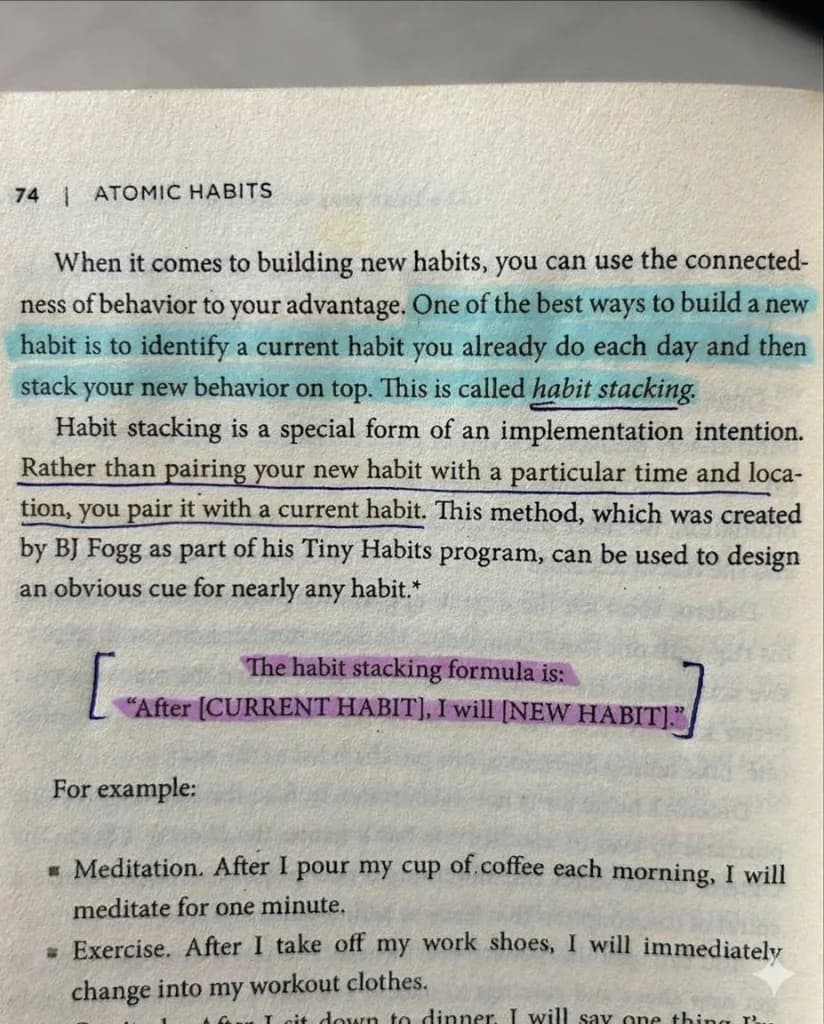
3. Habit Stacking
One of the most powerful techniques in the book. The formula: "After [CURRENT HABIT], I will [NEW HABIT]."
You're linking a new behavior to an existing one, using the existing habit as the cue. This works because existing habits are already deeply embedded in your neural pathways.
Habit Stacking Examples
☕ "After I pour my morning coffee, I will meditate for 1 minute."
🦷 "After I brush my teeth, I will do 10 push-ups."
💻 "After I sit down at my desk, I will write 3 sentences of my book."
📱 "After I open my phone, I will check my habit tracker first."
4. Environment Design
James Clear argues that environment is the invisible hand that shapes human behavior. You don't need more willpower — you need a better environment. Make the cues for good habits visible and obvious.
- Want to eat healthier? Put fruit on the counter, not in the fridge.
- Want to read more? Put your book on your pillow, not on the shelf.
- Want to exercise? Set out your gym clothes the night before.
- Want to drink more water? Put a water bottle on your desk.
The inverse — making bad habits invisible — is equally powerful. Remove the cue and the habit loses its trigger. Delete social media apps from your phone (you can still access them on desktop). Keep junk food out of the house entirely. Use website blockers during work hours.
2nd Law (Craving)
Make It Attractive
Habits are dopamine-driven feedback loops. The more attractive an opportunity appears, the more likely it is to become a habit. You can engineer attractiveness.
Strategies for Law 2
1. Temptation Bundling
Link a habit you need to do with a habit you want to do. The formula: "I will only [THING I WANT] while [THING I NEED TO DO]."
Temptation Bundling Examples
🎧 Only listen to your favorite podcast while exercising
📺 Only watch your favorite TV show while folding laundry
☕ Only drink your favorite coffee while reviewing your goals
🎵 Only play your favorite playlist while working on your most dreaded task
2. Join a Culture Where Your Desired Behavior Is Normal
We don't just imitate individuals — we imitate groups. The most effective thing you can do to build a habit is to join a culture where your desired behavior is the normal behavior. Want to read more? Join a book club. Want to exercise? Find a gym partner. Want to code? Join a developer community.
Clear cites the famous study of Polgar sisters — three sisters who all became chess grandmasters because they were raised in a household where chess mastery was the norm, not the exception.
3. Reframing: Highlight the Benefits, Not the Burdens
Many habits feel like obligations. Reframing can make them feel like opportunities. This isn't just positive thinking — it's a genuine cognitive shift that changes the emotional valence of the behavior.
- "I have to wake up early" → "I get to have quiet time before the world wakes up"
- "I have to exercise" → "I get to strengthen my body"
- "I have to save money" → "I get to build financial freedom"
3rd Law (Response)
Make It Easy
The most important factor in habit formation is not how long you've been practicing, but how often. Frequency matters more than duration. Reduce friction to make repetition automatic.
Strategies for Law 3
1. Reduce Friction
Every habit has a certain amount of friction — the effort required to start. The more friction, the less likely you are to do it. Your job is to engineer your environment to reduce friction for good habits and increase it for bad ones.
"The idea is to make your habits so easy that you'll do them even when you don't feel like it."
✅ Reduce Friction (Good Habits)
- • Prepare your running shoes by the door
- • Pre-chop vegetables on Sunday
- • Keep your journal on your desk, open
- • Set up your guitar in the living room, not the closet
❌ Increase Friction (Bad Habits)
- • Delete social apps from phone
- • Use a website blocker during work
- • Keep unhealthy food out of the house
- • Unplug the TV after each use
2. The Two-Minute Rule
This is one of the most immediately actionable techniques in the book. When you start a new habit, it should take less than two minutes to do.
The idea: nearly any habit can be scaled down to a two-minute version. The goal is to master the art of showing up. A habit must be established before it can be improved.
Two-Minute Rule Conversions
3. Commitment Devices
A commitment device is a choice you make in the present that controls your future behavior. You use the present self (who has good intentions) to lock in behavior for the future self (who may be tempted).
- Buying food in small packages (reduces overeating)
- Asking your partner to change the WiFi password during work hours
- Scheduling workouts as calendar events you can't easily delete
- Automating savings so you never see the money to spend it
For those who fully grasp the science but lack the stamina to show up daily, building a system centered on external accountability and financial stakes can often bridge the execution gap.
4th Law (Reward)
Make It Satisfying
The human brain evolved to prioritize immediate rewards over delayed ones. To make a habit stick, you need to add immediate satisfaction to behaviors whose benefits are delayed.
Strategies for Law 4
1. Habit Tracking
Habit tracking is one of the most satisfying and effective habit-building tools available. The act of tracking creates a visual record of your progress that itself becomes rewarding.
Jerry Seinfeld famously used a "don't break the chain" method — marking an X on a calendar every day he wrote. The visual chain of X's became its own motivation: "Don't break the chain."
Three Benefits of Habit Tracking
It creates a visual cue that reminds you to act
It provides immediate satisfaction — marking off a day feels good
It shows you how far you've come — momentum is motivating
2. The "Never Miss Twice" Rule
Life happens. You will miss a day. The critical rule: never miss twice. Missing once is an accident. Missing twice is the start of a new habit — the habit of not doing the thing.
The first mistake is never the one that ruins you. It's the spiral of repeated mistakes that follows. The rule "never miss twice" is a strategy for bouncing back quickly and maintaining your identity as someone who does the behavior.
3. Immediate Rewards
For habits with delayed payoffs (exercise, saving money, studying), add an immediate reward that you enjoy. This connects the action to its long-term benefits immediately.
- After every workout, allow yourself a specific treat you genuinely enjoy
- After every study session, watch one episode of your favorite show
- After every meditation, enjoy your morning coffee as a ritual
The key: make the reward actually immediate, and make sure it doesn't conflict with the habit's purpose (don't reward exercise with junk food that cancels it out).
Advanced Concept: The Goldilocks Rule
Humans experience peak motivation when working on tasks of just-manageable difficulty — not too hard, not too easy. Clear calls this the Goldilocks Rule. If a habit is too easy, you get bored. Too hard, you get discouraged. The sweet spot is ~4% beyond your current ability. This is why you need to progressively challenge your habits to maintain long-term engagement.
Want the full deep-dive on all four laws?
Read Chapter 3 Deep Dive →Identity-Based Habits: The Real Secret
This is arguably the most important concept in the entire Atomic Habits summary — and the one most people skip over. James Clear identifies three layers of behavior change:
Layer 1 (Outermost)
Outcomes
"I want to lose weight" · "I want to make money"
Layer 2
Processes
"I follow a meal plan" · "I exercise 3x/week"
Layer 3 (Core)
Identity
"I am a healthy person" · "I am an athlete"
Most people start from the outside in. Clear argues you must start from the inside out.
Most people try to change from the outside in: they set an outcome goal ("lose 20 pounds"), then figure out a process ("diet and exercise"). James Clear argues you should work from the inside out: first decide who you want to be, then prove it with small actions. Research in personality and self-concept psychology confirms that identity drives sustained behavioral change more reliably than external goals.
The Identity Shift in Practice
Old Identity
"I'm trying to quit smoking"
New Identity
"I'm not a smoker"
Old Identity
"I'm trying to exercise more"
New Identity
"I'm a person who never misses a workout"
Old Identity
"I want to write a book someday"
New Identity
"I'm a writer. I write every day."
How to Build a New Identity
Clear gives a two-step process that sounds almost too simple — but it works because it aligns with how our brains form beliefs:
- Decide the type of person you want to be. Not the outcome you want, but the identity. "I am someone who reads daily." "I am someone who exercises."
- Prove it to yourself with small wins. Every time you do the behavior — even once — you cast a vote for that identity. You're not aiming for perfection. You're aiming for evidence.
"Every action is a vote for the type of person you wish to become." This is why missing once isn't catastrophic — but missing twice starts to rewrite your identity narrative. The goal is never to be perfect. The goal is to be the type of person who shows up consistently, which is precisely why mastering self-control strategies and building discipline without motivation are natural next steps.
The Core Philosophy: 1% Better Every Day
The foundational insight of Atomic Habits is the mathematics of marginal gains. James Clear poses a simple question: What if you got just 1% better at something every day?
The Math of Marginal Gains
1.01³⁶⁵ = 37.783 | 0.99³⁶⁵ = 0.03
This isn't just motivational math. It reveals something important: the effects of habits are delayed. You don't see results immediately. The first weeks of a new habit feel pointless. That's why so many people quit — they expect linear results from exponential processes. This is also why understanding identity-based habits matters so deeply: your belief system sustains you through this invisible phase.
"You do not rise to the level of your goals. You fall to the level of your systems."
Goals vs. Systems: Why This Changes Everything
Most people focus obsessively on goals: lose 20 pounds, run a marathon, write a book. James Clear argues this is backwards. Goals and systems are not opposites — but systems are what actually produce results. Researchers in behavioral psychology have long supported the idea that consistent processes outperform outcome-focused thinking.
❌ Goal-Focused Thinking
- • "I want to lose 20 pounds"
- • "I want to write a novel"
- • "I want to run a marathon"
- Problem: Every person who achieves AND fails to achieve the goal had the same goal. The goal doesn't differentiate outcomes — the system does.
✅ Systems-Focused Thinking
- • Set out gym clothes the night before
- • Write 200 words every morning before email
- • Run every Tuesday/Thursday, no exceptions
- Why it works: You're not relying on motivation. You're building an environment that makes the behavior automatic.
The profound insight: winners and losers often have the same goals. Every Olympic athlete wants to win gold. Every startup founder wants to build a billion-dollar company. What separates them is their systems — the daily behaviors and environments they've engineered to make progress automatic. Pairing this systems thinking with techniques like habit stacking makes the approach even more effective.
If you've tried implementing these laws but still find yourself falling off track after a few weeks, it might be time to address the limits of relying purely on internal motivation.
Most Useful Atomic Habits Strategies
A quick-reference guide to the core execution tactics introduced across the 20 chapters:
Habit Scorecard
Audit your existing daily routines to build non-judgmental awareness of automatic cues.
Example: Saying "I am about to eat a chocolate cookie" out loud before taking a bite.
Implementation Intentions
Pre-decide the precise time and place you will perform a habit to remove decision friction.
Example: "I will meditate for 1 minute at 7:00 AM at my kitchen table."
Habit Stacking
Anchor a new target habit directly onto an existing daily routine you already do automatically.
Example: "After I pour my morning coffee, I will write 1 sentence in my journal."
Environment Design
Reshape your physical surroundings to make cues for good habits obvious and bad cues invisible.
Example: Placing a filled water bottle on your desk every morning and hiding phones in another room.
Two-Minute Rule
Scale down new habits so they take under 2 minutes, mastering showing up before optimizing.
Example: Downscaling "Read 30 pages" to "Read 1 page before bed."
Habit Tracking
Maintain a visual record of your habit execution (like marking X on a calendar) to create immediate satisfaction.
Example: Checking off daily workout boxes on a wall calendar.
Never Miss Twice
When a slip occurs, recover immediately. Missing once is an accident; missing twice starts a bad habit.
Example: If a emergency forces you to skip a workout on Tuesday, make sure you show up Wednesday.
Temptation Bundling
Pair an action you need to do with an action you want to do to leverage dopamine anticipation.
Example: Only listening to your favorite podcast while folding laundry or running on the treadmill.
Commitment Devices
Make choices in the present that lock in your future behavior and make bad choices impossible.
Example: Placing a timed lockbox over your router at 10:00 PM to enforce sleep routines.
Your 30-Day Atomic Habits Implementation Plan
Don't just read about habits — build them. This is a concrete, day-by-day plan to apply everything you've learned. Start today, not Monday.
Week 1: Foundation
Complete the Habit Scorecard. List every habit from morning to night and label each +, -, or =.
Choose ONE habit to build. Just one. Apply implementation intention: "I will [behavior] at [time] in [location]."
Apply the Two-Minute Rule to your chosen habit. Reduce it until it takes under 2 minutes.
Design your environment. Make one change that reduces friction for your habit or increases it for a bad one.
Create a habit stack. Attach your new habit to an existing one using "After [X], I will [Y]."
Do the habit both days. Mark it on a simple tracker. Start your streak.
Week 2: Reinforcement
Add identity language: Start saying "I am a [person who does X]" once per day
Add temptation bundling: pair your habit with something you enjoy
Set up a minimal habit tracker (paper or app)
Tell one person about your habit — social accountability
Review your habit stack and simplify if needed
Plan your "minimum viable version" for hard days
End of Month 1: Review & Expand
Review your Habit Scorecard — have any neutral habits shifted?
Add one more habit (only after the first is automatic)
Evaluate environment design — what other friction can you reduce?
Check in on your identity: are you starting to believe it?
Apply the Goldilocks Rule — is your habit too easy? Increase the challenge slightly.
Celebrate your streak — reward yourself for consistency, not just outcomes
Most Common Mistakes (And Exactly How to Fix Them)
❌ Mistake
Starting with too many habits at once
✅ Fix
Pick ONE habit. Master it for 30 days. Then add another.
❌ Mistake
Focusing on outcomes, not systems
✅ Fix
Stop measuring weight, pages read, or money saved. Measure streak days.
❌ Mistake
Treating missed days as failure
✅ Fix
Apply "never miss twice." One miss is noise. Two misses is a pattern.
❌ Mistake
Making habits too ambitious from day one
✅ Fix
Use the Two-Minute Rule. Start embarrassingly small. Consistency beats intensity.
❌ Mistake
Relying on motivation instead of systems
✅ Fix
Design your environment so the habit happens automatically, regardless of how you feel.
❌ Mistake
Ignoring identity — trying to change behavior without changing beliefs
✅ Fix
Ask: "What kind of person would do this habit?" Then act like that person.
Atomic Habits Key Takeaways
The 10 core principles to remember from James Clear's framework:
Small 1% daily changes compound into a 37x improvement over one year.
You do not rise to the level of your goals; you fall to the level of your systems.
True behavior change is identity change; every action is a vote for who you wish to become.
Environment is the invisible hand shaping human choice—design your surroundings to make cues obvious.
Optimize the 4-stage habit loop: Cue (Make It Obvious), Craving (Make It Attractive), Response (Make It Easy), Reward (Make It Satisfying).
Master the Two-Minute Rule: establish a habit by scaling it under 2 minutes before trying to optimize it.
Never miss twice: slips are accidents, but missing two days in a row starts a bad habit.
Use commitment devices and automations to lock in good future choices and make bad habits difficult.
Align your routines with your natural genetic strengths to play a game where the odds are in your favor.
The greatest threat to success is boredom, not failure—elite performers execute routines even when work gets mundane.