
Atomic Habits Chapter 16 Summary: Never Miss Twice Rule
How visual progress helps you stay consistent—and how to recover quickly when you miss a day.
Chapter 16 in Simple Words
Chapter 16 focuses on the 4th Law of Behavior Change: Make It Satisfying. James Clear demonstrates how habit tracking creates immediate visual proof of your progress, turning routine completion into a rewarding feedback loop.
The central rule of Chapter 16 is Never Miss Twice: missing one day of a habit is an isolated interruption, but missing two consecutive days starts a new pattern. When an inevitable lapse occurs, return to your routine as quickly as possible.
In Simple Words
Habit tracking gives you visual proof of today's effort. When you miss a day, get back on track immediately so one slip doesn't become a new routine.
Key Takeaway
The first rule of habit tracking: Never Miss Twice. If you miss one day, try to get back on track as quickly as possible.
The Paper Clip Strategy: Making Progress Visible
Clear illustrates the power of visual measurement through the story of Trent Dyrsmid, a 23-year-old stockbroker in Abbotsford, Canada.
Dyrsmid started each morning with two jars on his desk. One jar was filled with 220 paper clips; the other was completely empty. As soon as he dialed a sales prospect, he moved one paper clip from the full jar into the empty jar. He continued dialing until all 220 paper clips had been transferred.
Within eighteen months, Dyrsmid was generating significant business revenue. The secret was not the paper clips themselves—it was the visual feedback loop:
Action: Dial the phone
Visual Measurement: Move one paper clip
Immediate Feedback: See the empty jar fill up clip by clip
The paper clips provided tangible evidence of progress before any sales outcomes were closed.
Why Seeing Your Progress Can Keep You Going
Visual tracking works because it satisfies three basic behavioral needs:
- It makes a habit obvious: A calendar or tracker resting on your desk serves as a constant visual cue to act.
- It makes a habit attractive: Seeing a continuous streak of checkmarks inspires you to keep the streak going.
- It makes a habit satisfying: Marking a checkmark or moving a counter provides a momentary feeling of accomplishment.
The checkmark does not create your final result, but it gives you clear evidence that you showed up for your identity today.
Why Habit Tracking Feels Satisfying
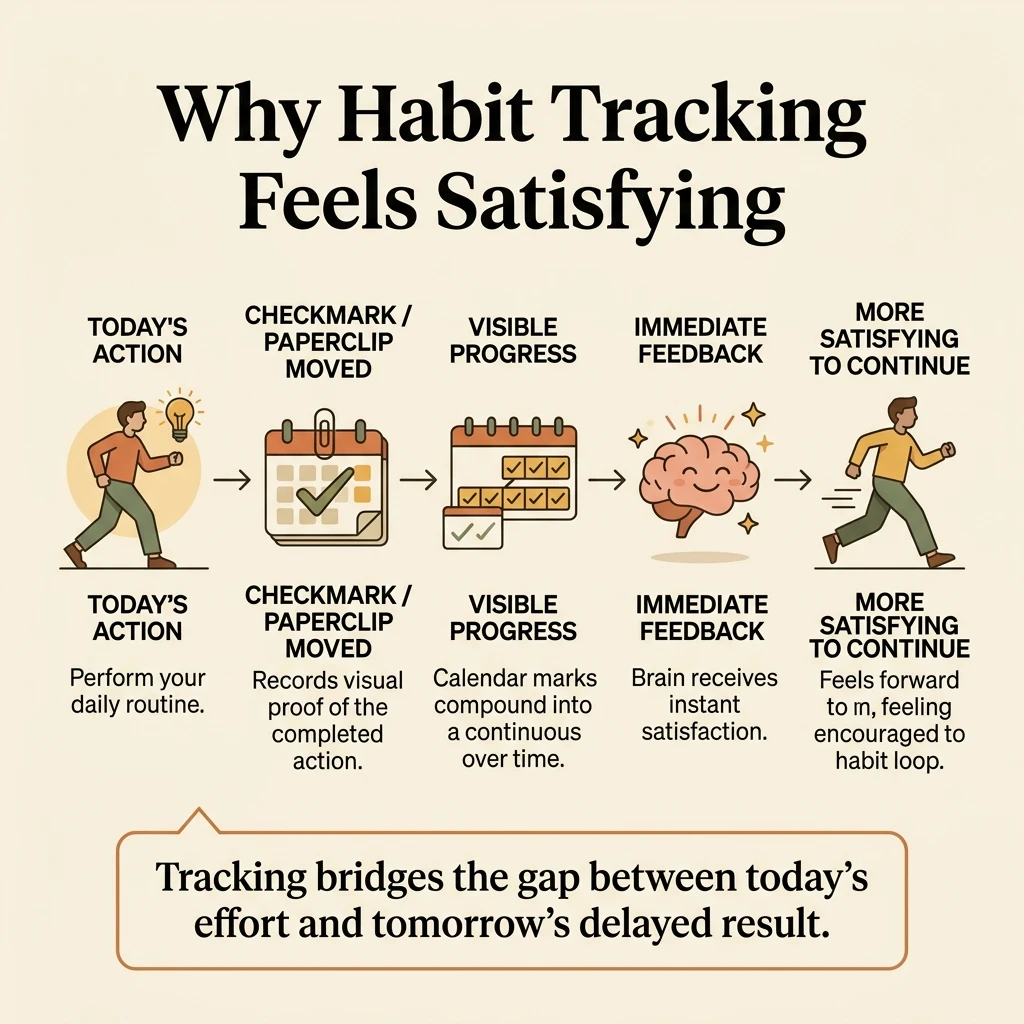
Tracking bridges the gap between today's effort and tomorrow's delayed result.
As shown in the diagram, performing your daily routine (Today's Action) and recording it (Checkmark/Paperclip) creates visual progress and immediate mental feedback, making the habit significantly more satisfying to sustain over time.
Ways to Track a Habit
There is no single best habit tracking method. The right choice depends on your daily environment and preferences:
| Tracking Method | Best For | Key Advantage | Possible Drawback |
|---|---|---|---|
| Wall Calendar | Simple daily routines (workout, reading) | Highly visible at a glance | Can lead to over-fixation on streaks |
| Paper Journal / Checklist | Auditing multiple habits simultaneously | Easy to customize with notes | Requires manual physical updating |
| Smartphone App | Digital nomads & mobile preferences | Automatic history and reminders | Can introduce digital screen distraction |
| Physical Counter (Jars / Clips) | Repetitive daily counts (sales calls, reps) | Tactile & highly satisfying | Less practical for complex behaviors |
Looking for templates or software? Download our free Printable Habit Tracker Templates, compare the 5 Best Habit Tracker Apps, or explore real adherence statistics in our Habit Tracking Research & Data Guide.
When to Record the Habit
James Clear emphasizes that habit tracking should be done as close to the action as possible.
If you wait until the end of the day to recall everything you accomplished, tracking becomes an imprecise chore. Instead, pair tracking directly with completion:
Finish reading 20 minutes → Mark calendar checkmark immediately.
Complete set of pushups → Move paperclip immediately.
Drink morning water → Check habit app immediately.
Immediate recording connects the completion of the behavior to the satisfaction of the mark.
Never Miss Twice: What to Do After a Bad Day
No matter how consistent you are, life will eventually interrupt your routine. You might get sick, travel across time zones, handle a work emergency, or simply feel exhausted.
Clear introduces a simple rule for consistency: Never Miss Twice.
Missing one day is an isolated event. Missing two consecutive days is the start of a new, unwanted habit.
The difference between a successful habit builder and someone whose routine collapses is not perfection—it is the speed of recovery.
One Miss vs. Repeated Pattern
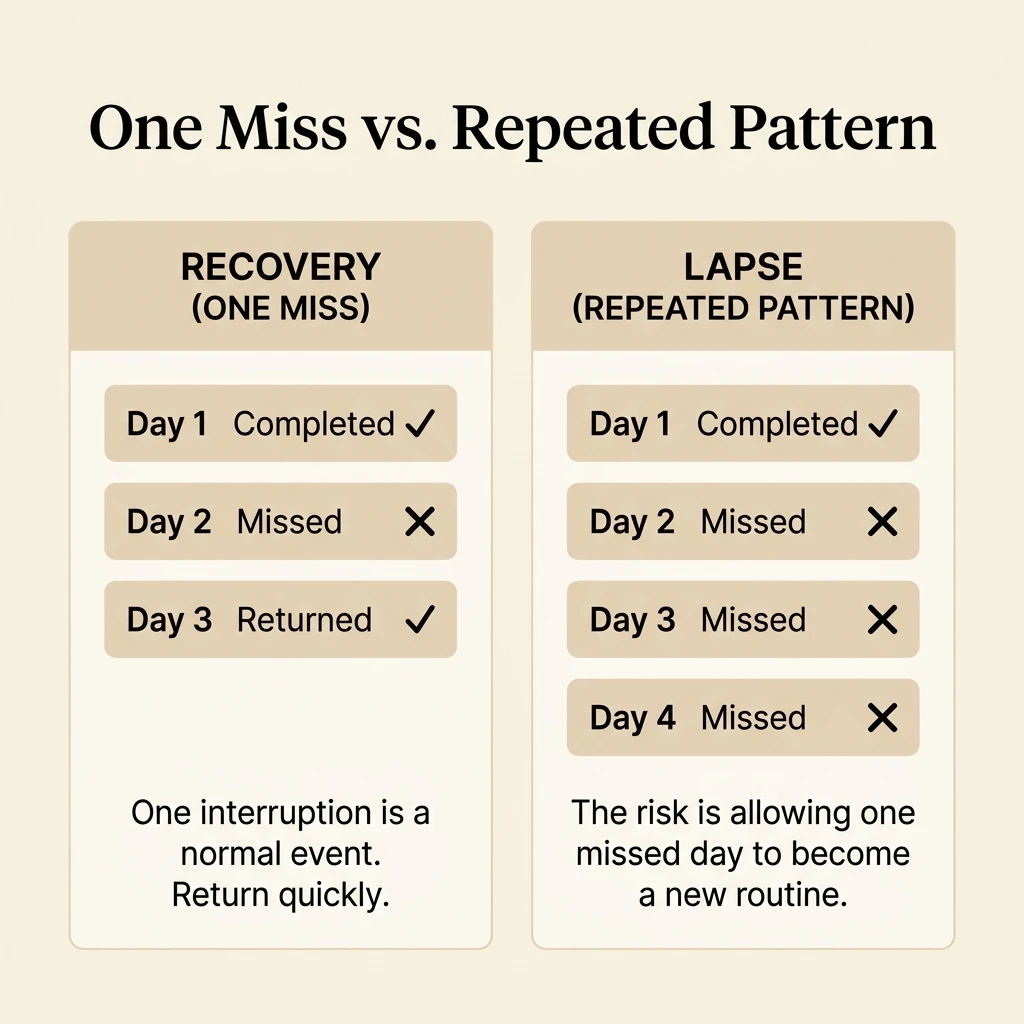
One interruption is a normal event. The risk is letting one missed day turn into a repeated pattern.
As illustrated, missing Day 2 is a temporary slip if you return on Day 3. However, letting Day 2 lead into Day 3 and Day 4 creates a new, unwanted habit of non-action.
Real-Life Recovery Scenarios
Scenario 1: Writing Goal
Ideal Day Target: Write 500 words.
Bad Day Reality: Exhausted after a late work meeting.
Never Miss Twice Recovery: Write just one sentence before bed.
Applying the Two-Minute Rule keeps the identity active without requiring high effort.
Scenario 2: Study Routine
Ideal Day Target: Study 60 minutes.
Bad Day Reality: Traveling for family responsibilities.
Never Miss Twice Recovery: Review one key concept card on the phone.
A scaled-down session preserves continuity so you don't restart from zero.
Scenario 3: Exercise Habit
Ideal Day Target: 45-minute gym session.
Bad Day Reality: Missed Tuesday's workout due to car trouble.
Never Miss Twice Recovery: Complete a 10-minute walk on Wednesday.
The goal of Wednesday's walk is not to compensate for Tuesday, but to prove you returned.
Never Miss Twice Does Not Mean Never Rest
It is essential to clarify that the Never Miss Twice rule is not a demand for relentless, uninterrupted labor.
Planned rest days—such as taking Sundays off from intensive training or scheduling a weekend break from study—are a deliberate part of a sustainable routine.
The rule applies specifically to unintended lapses. A planned day of recovery supports long-term consistency, whereas an unplanned multi-day drift degrades momentum.
When the Tracker Becomes the Goal
While habit tracking is effective, Clear cautions against a common trap known in economics as Goodhart's Law:
"When a measure becomes a target, it ceases to be a good measure."
If maintaining a 100-day streak becomes more important than the quality of the habit, you might start going through the motions just to check the box.
For example, someone might read one paragraph of a book while half-asleep just to keep a reading streak alive. While showing up matters, remember that the tracker is merely a tool to measure behavior—not the ultimate identity itself.
Track the Right Thing
To prevent tracking from becoming deceptive, ensure you measure the metric that best reflects your true target:
- Writing: Track focused writing sessions completed rather than total hours sitting at your desk.
- Studying: Track concepts mastered or practice problems solved rather than minutes having a textbook open.
- Exercise: Track completed planned workouts rather than relying solely on calorie burn estimates.
Avoiding Tracking Fatigue
Tracking requires effort. If you try to log 15 different daily habits at once, the tracking process itself becomes an overwhelming chore.
Keep your system simple by focusing on 1 to 3 foundational habits at a time. Once a habit becomes thoroughly automatic, you can retire its tracker and focus on a new behavior.
Build Your Own 30-Second Habit Tracker
You don't need an elaborate setup to begin visual habit tracking today:
- Choose 1 key habit: Pick the single behavior that matters most to your current goal.
- Define what counts: Specify exactly what constitutes a completed session.
- Pick a simple visual method: A wall calendar checkmark or a simple notebook tick.
- Record immediately: Log the action as soon as it is finished.
- Establish your recovery version: Define a smaller version for difficult days.
- Apply Never Miss Twice: If you miss a day, return at the very next opportunity.
Build Your 30-Second Habit Tracking Plan
Define your target habit, your minimum recovery version for bad days, and your tracking method.
Chapter 16 in One Minute
• Visual progress satisfies: Habit tracking provides immediate evidence of effort before final results appear.
• The Paper Clip Strategy: Moving physical markers creates an immediate feedback loop that encourages completion.
• Record immediately: Pair tracking directly with the completion of the action.
• Never Miss Twice: One missed day is an isolated slip; two missed days starts an unwanted pattern.
• Fast recovery beats perfection: Use scaled-down recovery versions on bad days to maintain continuity.
• Planned rest is valid: Never Miss Twice prevents unintended drift—it is not a ban on planned rest.
• Beware Goodhart's Law: Don't let the tracking streak become more important than the quality of the habit.
• Keep it simple: Track 1 to 3 foundational habits to prevent tracking fatigue.
Need a quick reference?
Get the entire Atomic Habits system condensed into a fast, actionable guide.
Frequently Asked Questions
Q: What is Chapter 16 of Atomic Habits about?
A: Chapter 16 covers the 4th Law of Behavior Change: Make It Satisfying. James Clear explains how habit tracking provides immediate visual feedback, how to use the Paper Clip Strategy, and how to apply the Never Miss Twice rule when a streak is interrupted.
Q: What is the Never Miss Twice rule?
A: The Never Miss Twice rule is a recovery strategy stating that missing one day of a habit is a temporary interruption, but missing two days starts a new pattern. The goal is to return to the habit as quickly as possible after a lapse.
Q: Why does habit tracking help with consistency?
A: Habit tracking creates immediate visual proof of your progress. Because long-term rewards take time to materialize, recording a checkmark or moving a paperclip gives your brain instant satisfaction for completing today's effort.
Q: What is the Paper Clip Strategy?
A: The Paper Clip Strategy is a visual measurement technique used by stockbroker Trent Dyrsmid. He placed two jars on his desk—one filled with 220 paper clips and one empty—and moved a clip after every sales call until the target was met.
Q: Does Never Miss Twice mean you can never take a rest day?
A: No. Planned rest days are part of your routine structure. The Never Miss Twice rule is designed to prevent unintended slips from turning into repeated multi-day lapses.
Q: Can habit tracking become counterproductive?
A: Yes. When the tracking number or streak becomes more important than the quality of the behavior (Goodhart's Law), tracking can lead to superficial compliance rather than genuine progress.
Transition to Next Chapters
Habit tracking creates internal satisfaction and visual feedback. Chapter 17 adds an external layer of accountability to make unwanted habits harder to repeat.
Previous Chapter
← Chapter 15: Cardinal Rule of Behavior Change
Read Next
Chapter 17: Accountability Partner →
Recommended Reading & Next Steps
Explore related chapter breakdowns, interactive tools, and practical guides:
Identity-Based Habits & Identity Circle
Learn how identity shapes habits, the 3 layers of behavior change, and how actions cast votes.
Atomic Habits for Athletes: Marginal Gains
How competitive athletes apply British Cycling systems, pre-game anchors, and recovery loops.
Why Atomic Habits Doesn’t Work for Some People
A critical analysis of willpower limitations, ADHD hurdles, and systemic habit failure.