
Atomic Habits Chapter 6 Summary: Environment Over Motivation
How changing the cues around you can make good habits easier to notice and bad habits easier to avoid.
Chapter 6 in Simple Words
Chapter 6 belongs to the 1st Law of Behavior Change: Make It Obvious. James Clear argues that motivation fluctuates from day to day, whereas your environment remains a constant physical presence.
If the objects and cues connected to a good habit are visible and easy to access, the behavior becomes much easier to notice and start. Conversely, if the cues for an unwanted habit are hidden or inconvenient, the behavior is far less likely to happen automatically.
In Simple Words
Instead of asking yourself to feel motivated every time, change what is around you. Put the things that support good habits where you can easily see and use them, and make unwanted habits less visible or convenient.
Key Takeaway
You do not always need more motivation. Sometimes you need an environment that makes the right behavior easier to notice and the wrong behavior harder to start.
Before vs. After: Design Your Environment
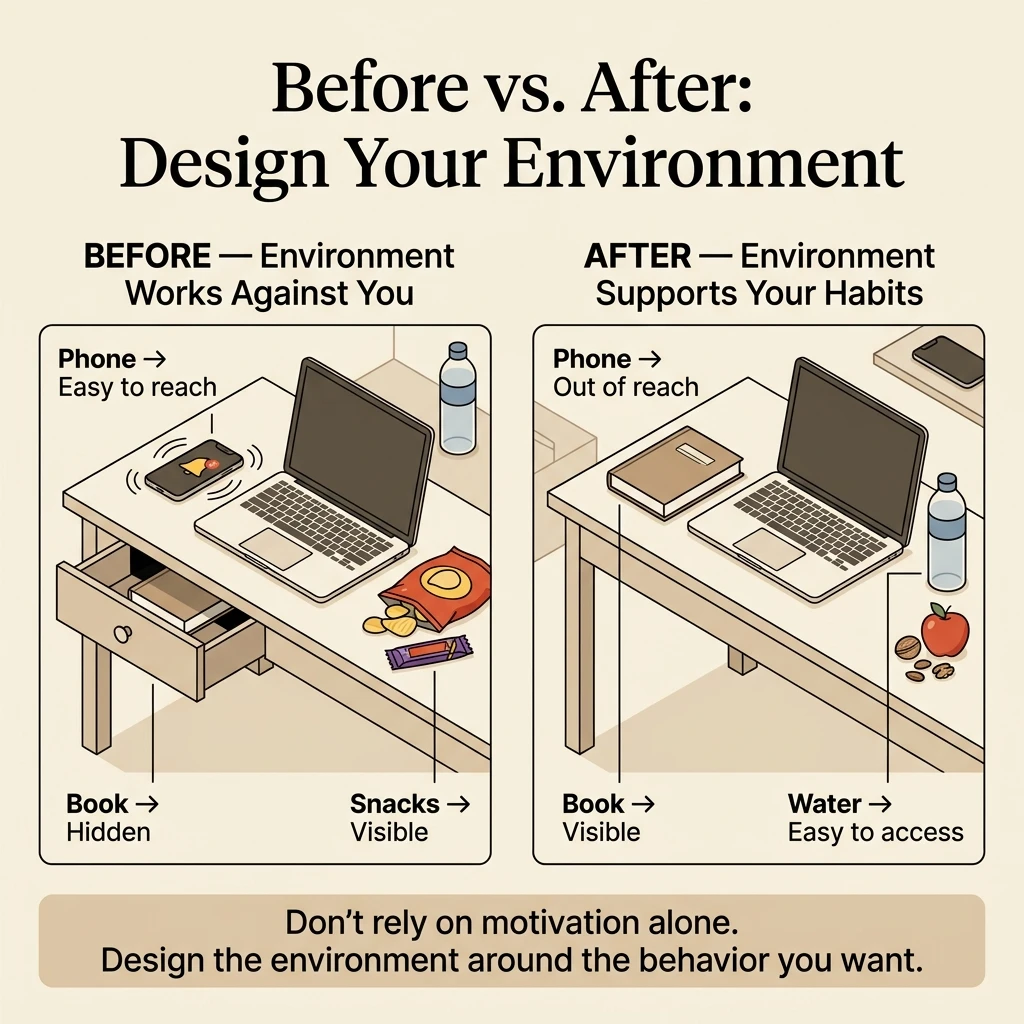
Changing the environment can make desired habits easier to notice and unwanted habits less convenient.
In the visual above, the person did not suddenly develop willpower or more motivation. Instead, the physical environment was redesigned: cues for positive habits (like reading and drinking water) were made visible and accessible, while cues for distraction (like the smartphone) were moved out of immediate reach.
The goal is not to eliminate the need for motivation. It is to make the environment work with the behavior you want instead of constantly working against it. (Read our tactical guide on How to Build Discipline Without Motivation for detailed architectural setups).
The same principle appears in Chapter 6’s discussion of choice architecture: changing how options are presented can influence which behaviors are easier to notice and choose. In Chapter 7, Clear explains how to invert this principle by making bad habit cues invisible.
The Hospital Cafeteria Experiment: Choice Architecture
To demonstrate how environment influences behavior without relying on motivation, Clear shares a famous study led by Dr. Anne Thorndike at Massachusetts General Hospital.
The researchers wanted to improve the eating habits of hospital patrons without talking to them or trying to persuade them. Over six months, they simply altered how drinks were arranged in the cafeteria. Bottled water was placed next to cash registers and added to refrigerators that previously contained only soda.
Study Results (Mass General Hospital):
• Bottled water sales increased by 25.8%
• Soda sales decreased by 11.4%
The study illustrates how subtle adjustments to the choice environment can influence behavior without requiring deliberate persuasion or increased motivation.
What Is Choice Architecture?
Choice architecture is the practice of arranging options in an environment to influence what people notice, select, or find convenient.
Every environment has a choice architecture. When fruit is placed at eye level in a kitchen, it gets eaten more often. When a phone is placed next to your pillow, it gets picked up more easily. You are constantly making choices within the architecture designed around you.
Your Environment Is Full of Cues
Habits begin with cues. Your environment constantly exposes you to objects, locations, visual signals, and physical arrangements that suggest specific actions:
Visible Cue: Highly noticeable → Reminds you of the habit → Increases likelihood of action.
Hidden Cue: Requires extra effort to find → Forgotten easily → Decreases likelihood of action.
Clear notes that vision is the most powerful sensory input for human beings. Making visual cues obvious is often the single most effective environmental change you can make.
What Counts as an Environmental Cue?
Environmental cues come in several distinct forms:
How to Design Your Environment for Good Habits
To build a positive routine, adjust your surroundings to make the trigger easy to notice:
- Make the Cue Obvious: Place the primary object needed for your habit in a prominent, visible location.
- Put Objects Where the Behavior Happens: If you want to drink water while working, keep the bottle on your work desk rather than in the kitchen.
- Prepare in Advance: Lay out your workout clothes or study materials the evening before.
- Create Multiple Cues: If a habit matters deeply (like staying hydrated), place cues in several locations (desk, car, nightstand).
How to Make Bad Habits Less Visible
The inverse of the 1st Law is: Make It Invisible.
Instead of relying on self-control to resist temptation, remove or hide the environmental trigger:
- Phone Scrolling: Charge your phone in another room overnight.
- Unhealthy Snacking: Keep cookies inside a high cupboard or out of the house entirely.
- Distracting Apps: Remove social media icons from your main home screen.
When the Whole Environment Becomes a Cue
Over time, habits stop being triggered by single isolated objects and become associated with an entire space or context.
For example, sitting on a particular couch may trigger the automatic urge to watch TV. Sitting at your office desk may trigger work focus. The entire room becomes the cue for a cluster of habits.
Why Separate Spaces Can Help
Clear recommends the principle: One space, one use.
When you mix contexts—such as working, eating, and watching videos all in bed—the cues become blurred, making it harder for your brain to associate the space with one specific behavior.
If your living space is small, create distinct micro-zones: one side of a table for studying, another for eating, or a specific chair reserved solely for reading.
Why a New Environment Can Make Habits Easier to Change
Existing environments are filled with old, ingrained habit cues. When you enter a new space—like a library, coffee shop, or new office—the old triggers are absent.
This makes it easier to establish a fresh routine without fighting against existing environmental associations.
Motivation vs. Environment: Which Should You Rely On?
Rather than viewing this as a strict binary, consider how both forces function together:
| Factor | Motivation | Environment Design |
|---|---|---|
| Consistency | Fluctuates daily based on mood & energy | Stays constantly present around you |
| Primary Role | Great for initiating a new goal | Great for sustaining daily consistency |
| Long-term Effort | Requires high continuous willpower | Reduces reliance on willpower |
Motivation still matters, but environment design reduces how often you must rely on willpower to perform the right action.
Real-Life Environment Design Examples
1. Reading More Instead of Scrolling
Situation: Someone wants to read every night but automatically reaches for their phone after getting into bed.
Environment Problem: The phone is beside the bed while the book is inside a drawer.
Environment Change: Move the phone charger outside the bedroom and place the book directly on the pillow or bedside table.
Why It Works: The phone is no longer the most obvious option, while the book becomes the visible cue for bed.
2. Making Healthy Snacks Easier to Choose
Situation: Someone wants to eat more fruit but usually grabs cookies when hungry.
Environment Problem: Cookies sit on the counter while fruit is stored inside a refrigerator drawer.
Environment Change: Move fruit into a visible bowl on the counter and store less healthy snacks inside a high cabinet.
Why It Works: The healthier choice becomes easier to notice and access during moments of hunger.
3. Making Exercise Easier to Start
Situation: Someone plans to exercise before work but feels too lazy to prepare clothes in the morning.
Environment Change: Lay out workout clothes and shoes right beside the bed the night before.
Why It Works: The environment provides a cue immediately upon waking and removes several preparation steps.
4. Reducing Mindless Phone Checking
Situation: Someone checks their phone repeatedly while trying to focus on work.
Environment Problem: The phone sits directly beside the keyboard with notifications appearing constantly.
Environment Change: Turn off non-essential notifications and place the phone several feet away in another room during focus hours.
Why It Works: Removing visual cues and adding physical distance creates a buffer before checking.
5. Creating a Dedicated Study Environment
Situation: A student tries to study at the desk where they normally watch videos and browse social media.
Environment Problem: The desk context is strongly associated with entertainment.
Environment Change: Design a dedicated study zone: phone away, textbook open, only required study tabs open.
Why It Works: The specific context becomes associated exclusively with focus and studying.
Common Environment Design Mistakes
- Relying Only on Motivation: Waiting for willpower instead of modifying physical cues around you.
- Making Good Habits Hard to Start: Storing tools away in drawers or closets where they are easy to forget.
- Keeping Bad Habit Cues Everywhere: Leaving tempting distractions directly on your desk or nightstand.
- Changing Too Many Things at Once: Overhauling your entire home at once instead of testing one room or desk zone first.
- Assuming Environment Solves Everything: Expecting environment changes to work without any personal intent.
How to Redesign Your Environment Today
A simple 6-step framework to adjust your surroundings:
- Step 1 — Choose One Good Habit: Select one habit you want to build (e.g., drink more water).
- Step 2 — Identify Current Cues: Notice what visual signals currently surround you.
- Step 3 — Make the Cue Obvious: Place the primary object in a prominent spot.
- Step 4 — Remove One Bad Habit Cue: Move one major distraction out of sight.
- Step 5 — Reduce Friction: Prepare necessary tools the evening before.
- Step 6 — Test for One Week: Observe whether the change makes starting easier.
Chapter 6 Quick Reference Table
| Goal | Environment Change | Intended Effect |
|---|---|---|
| Read more | Book on desk or pillow | Makes reading cue visible |
| Drink more water | Water bottle on work desk | Makes water easier to notice |
| Exercise morning | Shoes & clothes by door | Reduces morning prep steps |
| Reduce phone use | Charge phone outside room | Removes immediate trigger |
| Eat healthier | Fruit bowl on counter | Makes healthy option obvious |
Need a quick reference?
Get the entire Atomic Habits system condensed into a fast, actionable guide.
Frequently Asked Questions
Q: What is Chapter 6 of Atomic Habits about?
A: Chapter 6 explains that environment often matters more than motivation. By designing your surroundings so cues for good habits are visible and bad habits are hidden, you rely less on willpower.
Q: Why does environment matter more than motivation?
A: Motivation fluctuates based on mood and fatigue, whereas your environment is constantly present. A well-designed environment provides reliable cues that make positive habits easier to notice.
Q: What is choice architecture?
A: Choice architecture refers to how choices are arranged or presented in an environment, which strongly influences what people notice, select, or find convenient.
Q: How does environment affect habits?
A: Environment exposes you to visual signals and physical friction. Visible, accessible objects trigger action, while hidden or inconvenient objects reduce automatic triggers.
Q: Can changing your environment replace motivation entirely?
A: No. Motivation is still helpful for initiating change, but environment design reduces how often you must rely on willpower to stay consistent.
Q: What is an example of environment design in Atomic Habits?
A: An example is keeping a water bottle directly on your desk to encourage drinking more water, or charging your phone in another room to reduce late-night scrolling.
Recommended Reading & Next Steps
Explore related chapter breakdowns, interactive tools, and practical guides:
Build Discipline Without Motivation
How top performers design environmental constraints that eliminate the need for willpower.
The Secret to Self-Control (Make It Invisible)
Invert the 1st Law by eliminating environmental cues that trigger bad habits.
The Law of Least Effort & Friction
Reduce friction for good habits and increase friction for unwanted behaviors.