
Atomic Habits Chapter 12 Summary: Law of Least Effort
Why reducing friction can make good habits easier to start and repeat.
Chapter 12 in Simple Words
Chapter 12 continues the 3rd Law of Behavior Change: Make It Easy. James Clear introduces the Law of Least Effort: when people choose between similar options, they naturally gravitate toward the option requiring less effort.
Every extra decision, preparation step, or physical barrier creates friction. If you want to make a good habit consistent, decrease the friction between intention and action. If you want to break an unwanted habit, increase the friction until the behavior is no longer convenient.
In Simple Words
Make the habit you want easier to start, and make the habit you want to avoid more inconvenient.
Key Takeaway
Instead of asking yourself to try harder every time, redesign the steps around the behavior so the action you want requires less effort.
High Friction vs. Low Friction Habits
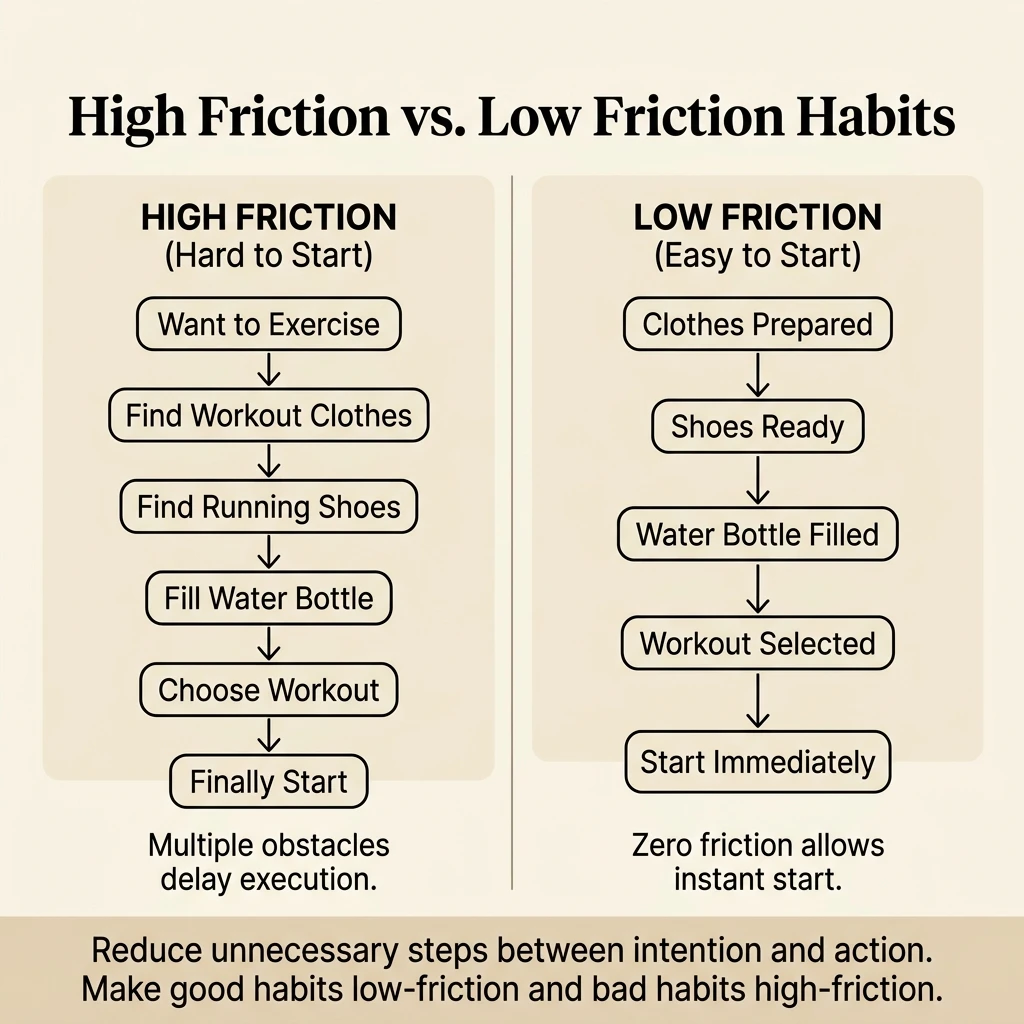
Reduce unnecessary steps between intention and action. Make good habits low-friction and bad habits high-friction.
In the diagram above, high-friction habits involve multiple preparation steps (finding clothes, finding shoes, filling bottles, selecting workouts) that exhaust willpower before starting. Low-friction habits remove those barriers in advance so execution happens smoothly.
The goal is not to eliminate all effort, but to remove unnecessary obstacles between your decision to act and the performance of the habit.
What Is the Law of Least Effort?
In psychology and behavioral science, the Law of Least Effort describes a fundamental principle of human behavior: when choosing between two reasonably similar options, people naturally favor the option requiring the least amount of effort.
In Atomic Habits, James Clear explains that this is not a moral judgment or a sign of laziness. It is an evolutionary conservation of energy. When an action requires high friction, you are far less likely to repeat it consistently. When an action requires minimal friction, it becomes significantly easier to start.
What Does "Friction" Mean in Habit Building?
Friction is any extra effort, step, decision, or physical inconvenience between you and the behavior you want to perform.
Why Geography Illustrates the Law of Least Effort
Clear uses Jared Diamond's analysis from Guns, Germs, and Steel to illustrate how environmental difficulty shapes behavior.
Agriculture spread much faster along the east-west axis of Eurasia than along the north-south axis of the Americas. Why? Because places along the same latitude share similar climates, day lengths, and weather patterns. Crops could be transported east or west with minimal adaptation friction. Moving crops north or south required adapting to drastically different climates—creating high environmental friction.
The habit lesson is clear: small differences in environmental difficulty dictate what becomes easier to adopt and sustain over time.
How to Reduce Friction for Good Habits
To make positive routines consistent, look for micro-steps you can eliminate:
- Exercise: Lay out workout clothes, shoes, and water the evening before so morning execution requires zero decisions.
- Reading: Keep a book on your desk or nightstand so picking it up takes one second.
- Healthy Cooking: Wash and chop vegetables on Sunday so preparing weeknight dinners takes minimal effort.
- Studying: Keep your laptop charged and study notes open to the current page.
- Saving Money: Set up automated bank transfers so saving happens without requiring a monthly decision.
Addition by Subtraction: Remove the Obstacle
Improving a habit often does not require adding another tool, app, or strategy. It requires removing one friction point.
If you want to practice guitar, storing it inside a hard case in the closet adds 30 seconds of friction. Placing the guitar on a stand in the living room removes that obstacle entirely.
Prime Your Environment for Future Use
One of the most practical concepts in Chapter 12 is priming your environment for your future self.
When you finish an activity, spend 60 seconds resetting the space so it is ready for the next session:
- After working: Clean your desk and open the document you need to work on tomorrow morning.
- After studying: Organize your notes and leave the textbook open to the next chapter.
- After dinner: Wash the dishes and wipe the counters so morning coffee happens in a clean kitchen.
Use Friction in Both Directions
Friction can be controlled strategically depending on your goal:
| Goal | Friction Strategy | Example Action |
|---|---|---|
| Build Good Habit | Decrease Friction | Keep book visible on pillow |
| Break Bad Habit | Increase Friction | Charge phone in another room |
| Reduce TV Binging | Increase Friction | Unplug TV after each use |
Friction Isn't Always the Enemy
Friction is not inherently bad. Adding friction to undesirable behaviors creates a momentary pause that interrupts automatic, impulse-driven habits.
Logging out of social media apps, keeping snacks in high cabinets, or leaving your phone in another room during focus hours are all constructive uses of friction.
Real-Life Scenarios Across 5 Everyday Domains
1. Making Morning Exercise Easier
Scenario: Someone wants to exercise before work but repeatedly postpones it because morning setup feels exhausting.
Current Friction: Clothes are buried in drawers, shoes are elsewhere, water bottle is empty.
Environment Change: Lay out clothes, shoes, filled water bottle, and workout plan the night before.
Why It Helps: Removes multiple small barriers before the moment when motivation may be low.
2. Reading Before Bed Instead of Scrolling
Scenario: Someone intends to read before sleep but automatically reaches for their phone.
Current Friction: Book is inside a drawer; phone sits right on the bedside table.
Environment Change: Place book on the pillow; move phone charger outside the bedroom.
Why It Helps: Desired habit becomes instant to start, while unwanted scrolling requires walking into another room.
3. Making Healthy Cooking Convenient
Scenario: Someone plans to cook dinner but orders food because meal prep feels too tedious after work.
Current Friction: Vegetables are unwashed and uncooked; pans are stored away.
Environment Change: Pre-wash and chop ingredients on Sunday; leave cooking pans ready.
Why It Helps: The hardest preparation steps are already completed.
4. Reducing Study Friction
Scenario: A student wastes 15 minutes preparing their desk every time they want to study.
Environment Change: At the end of today's session, organize notes and leave the textbook open to tomorrow's chapter.
Why It Helps: Tomorrow's session begins instantly with zero setup friction.
5. Adding Friction to Phone Distractions
Scenario: Someone checks social media repeatedly while trying to focus on work.
Current Friction: Almost zero—phone sits right beside keyboard with notifications popping up.
Environment Change: Turn off non-essential notifications and place phone in another room.
Why It Helps: Checking the phone now requires standing up and walking into another room.
Common Mistakes When Applying the Law of Least Effort
- Relying Only on Willpower: Expecting high motivation to overcome high-friction surroundings.
- Making Good Habits Complicated: Adding complex tracking apps or multi-step setup rituals.
- Leaving Bad Habits Frictionless: Keeping smartphones, junk food, or TV remotes within arm's reach.
- Confusing Easy With Effortless: Expecting zero effort. The goal is removing unnecessary friction, not hard work.
- Trying to Remove Every Obstacle: Removing necessary safety or quality checks.
How to Reduce Friction Today
- Step 1 — Pick One Good Habit: Select one routine you want to make consistent.
- Step 2 — List Every Step: Write down all preparation steps required to begin.
- Step 3 — Find the Biggest Friction Point: Identify which step causes the most hesitation.
- Step 4 — Remove That Step: Pre-position tools or materials in advance.
- Step 5 — Add Friction to One Bad Habit: Move one major distraction out of reach.
- Step 6 — Prime Tomorrow's Space: Spend 60 seconds preparing your desk or room before sleep.
Quick Reference Table
| Goal | Reduce Friction | Add Friction to Bad Habit |
|---|---|---|
| Read more | Keep book visible on pillow | Charge phone outside bedroom |
| Exercise | Lay out clothes/shoes night before | Disable social media notifications |
| Eat healthier | Pre-chop fresh vegetables | Keep snacks in high cabinets |
| Study | Leave notes open to next chapter | Put phone in another room |
| Work deeply | Open required document in advance | Log out of distracting websites |
How Chapter 12 Leads Into Chapter 13
Chapter 12 focuses on reducing environmental friction so habits are easier to start. Chapter 13 takes this concept one step further by shrinking the starting action itself down to under two minutes.
Explore our full breakdown in Atomic Habits Chapter 13: Two-Minute Rule Explained.
Need a quick reference?
Get the entire Atomic Habits system condensed into a fast, actionable guide.
Frequently Asked Questions
Q: What is the Law of Least Effort in Atomic Habits?
A: The Law of Least Effort states that when presented with similar choices, people naturally gravitate toward the option requiring the least effort. Reducing friction makes good habits easier to choose.
Q: What does friction mean in Atomic Habits?
A: Friction is any extra effort, step, decision, or inconvenience between you and the behavior you want to perform.
Q: How do you reduce friction for good habits?
A: Reduce friction by preparing materials in advance, keeping tools visible and accessible, and removing unnecessary preparation steps before starting.
Q: How do you increase friction for bad habits?
A: Increase friction by adding physical or digital barriers, such as placing your phone in another room or logging out of distracting social media apps.
Q: How do you prime your environment for a habit?
A: Priming your environment means setting up your surroundings today (laying out workout clothes or leaving notes open) so tomorrow’s habit requires zero setup.
Q: Is the Law of Least Effort the same as being lazy?
A: No. The concept describes a natural human tendency to prefer lower-effort options. It is an environmental strategy, not a moral judgment.
Q: Is the Two-Minute Rule part of Chapter 12?
A: The Two-Minute Rule is developed primarily in Chapter 13. Chapter 12 focuses more broadly on reducing friction and environmental preparation.
Recommended Reading & Next Steps
Explore related chapter breakdowns, interactive tools, and practical guides:
Identity-Based Habits & Identity Circle
Learn how identity shapes habits, the 3 layers of behavior change, and how actions cast votes.
Atomic Habits for Athletes: Marginal Gains
How competitive athletes apply British Cycling systems, pre-game anchors, and recovery loops.
Why Atomic Habits Doesn’t Work for Some People
A critical analysis of willpower limitations, ADHD hurdles, and systemic habit failure.