
Chapter 4 — The Man Who Didn't Look Right
Before you can change an automatic habit, you have to notice it.
Chapter 4 in Simple Words
Chapter 4 opens the 1st Law of Behavior Change: Make It Obvious. James Clear explains that habits become automatic through non-conscious mental processing. Before you can change an unwanted behavior, you must bring it into conscious awareness.
Clear introduces two practical tools for building awareness: the Habit Scorecard (listing daily behaviors and marking them +, -, or =) and Pointing-and-Calling (vocalizing an action out loud to interrupt autopilot).
In Simple Words
You can't fix a bad habit if you don't notice you're doing it. Say your habits out loud or write them down on paper to wake up your conscious mind.
Key Takeaway
Until you make the unconscious conscious, it will direct your life and you will call it fate.
The Man Who Didn't Look Right
James Clear begins Chapter 4 with the story of a paramedic who attended a family gathering. Upon glancing at her father-in-law, she immediately said, "I don't like the way you look," and insisted he go to the hospital straight away.
Medical scans revealed a major blockage in a primary artery. Without immediate intervention, he was at imminent risk of a fatal heart attack. When asked how she knew, the paramedic couldn't pinpoint a single obvious symptom. Her years of emergency room experience had trained her brain to recognize subtle visual cues—facial paleness, skin texture, breathing patterns—on autopilot without consciously reasoning through them.
That same ability that allows an experienced professional to notice a hidden medical problem is what makes everyday human habits so powerful: your brain constantly processes environmental cues without requiring your conscious attention.
Your Brain Learns What to Notice
With repetition and experience, your brain encodes familiar environmental cues into automatic responses. You don't have to consciously decide to turn on the bathroom light when walking into a dark room—your hand flicks the switch automatically.
Common automatic habit cues include:
- Hearing a phone chime → Hand reaches for the device before you consciously decide to look.
- Sitting on the couch after dinner → Reaching for the remote to open a streaming app.
- Feeling a wave of work stress → Reaching into a desk drawer for a snack.
- Getting into bed → Unlocking the smartphone screen to start scrolling.
Automatic processing is efficient because it conserves mental energy. However, it also means that unwanted behaviors can execute repeatedly before you realize they have started.
You Can't Change What You Don't Notice
Before you attempt to change a habit, you must first observe it without judgment.
When someone says, "I waste too much time online," that statement is too vague to act on. To create meaningful change, break the sequence down into its observable cues:
Deconstructing the Automatic Cue Sequence:
9:10 PM → Finish dinner → Sit on couch → Pick up phone → Open app → Watch one clip → 45 minutes of mindless scrolling.
Now the routine is visible. You are no longer fighting a vague feeling of guilt—you have identified the exact starting cue.
Why Saying the Action Out Loud Helps
To demonstrate how to convert automatic behaviors into conscious awareness, Clear highlights the Pointing-and-Calling system used by Japanese railway conductors.
As a train approaches a signal, the conductor points directly at the light and speaks the status out loud: "Signal is green!" When approaching a speed limit sign, the conductor points and calls out: "Speed is 70 kilometers per hour!"
By raising physical pointing and vocal speech into an automated routine, the system converts a silent mental check into an active physical observation. Studies show this simple practice reduces workplace errors by bringing automatic autopilot actions back into conscious focus.
You can apply Pointing-and-Calling to everyday habits by verbalizing what you are about to do before doing it:
- Instead of silently opening social media: "I am opening Instagram right now because I feel bored."
- Instead of grabbing a second cookie: "I am eating another cookie even though I am not hungry."
- Instead of skipping your study session: "I am choosing to close my textbook to watch TV."
Verbalizing the action forces your conscious mind to acknowledge the decision before the automatic habit completes.
Automatic Habit → Conscious Awareness
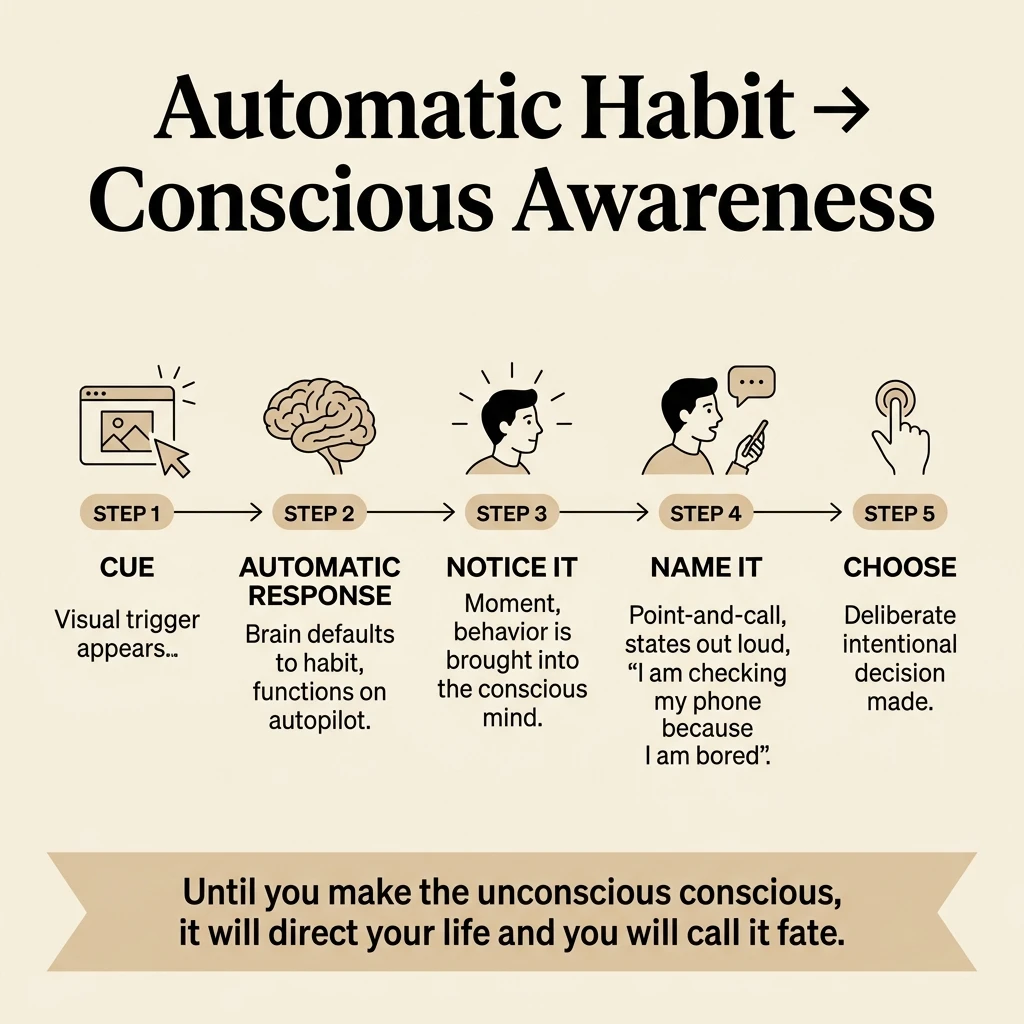
Until you make the unconscious conscious, it will direct your life and you will call it fate.
As illustrated in the diagram above, an automatic habit moves directly from Cue to Response without conscious thought. By noticing the moment and naming the action out loud ("I am checking my phone because I am bored"), you create a pause between trigger and response, restoring your ability to make a deliberate choice.
The Habit Scorecard: Put Your Day on Paper
The primary practical exercise introduced in Chapter 4 is the Habit Scorecard.
To create a Habit Scorecard, list your daily habits in chronological order from the moment you wake up to the moment you go to sleep. Once listed, evaluate each behavior by asking:
+ (Positive): Does this habit help me become the person I want to be?
- (Negative): Does this habit move me away from my target identity/goals?
= (Neutral): Is this habit a basic routine with no major impact either way?
A habit is not universally "good" or "bad." The score depends entirely on your personal goals. Drinking coffee black might be neutral for one person but negative for someone trying to reduce caffeine intake.
Example: A Typical Morning Scorecard
Here is what a simple morning Habit Scorecard looks like in practice:
| Time | Habit Action | Score | Why |
|---|---|---|---|
| 7:00 AM | Turn off alarm | = | Neutral basic routine |
| 7:02 AM | Scroll social media in bed for 20 min | - | Delays planned morning routine |
| 7:25 AM | Drink a glass of water | + | Supports hydration goal |
| 7:30 AM | Brush teeth & wash face | = | Standard personal hygiene |
| 7:45 AM | Skip breakfast while rushing out | - | Conflicts with energy & health goals |
| 8:00 AM | Review top 3 daily priorities | + | Supports focused work goal |
The Scorecard Doesn't Fix the Habit — It Shows You Where to Look
The Habit Scorecard is an auditing exercise, not a self-punishment tool. Avoid judging or criticizing yourself for negative habits. The goal is simple, objective observation:
Before creating a scorecard, someone might say: "I am terrible at managing my mornings."
After filling out a scorecard, that same person can pinpoint the exact issue: "At 7:02 AM, picking up my phone in bed creates a 20-minute delay that forces me to rush everything else."
The scorecard transforms vague self-criticism into visible, specific data points. You can use our interactive widget below or download the printable PDF version on our dedicated Habit Scorecard Worksheet.
Habit Scorecard Template
Map your daily habits, mark what helps or hurts your goals, and spot the patterns you may be running on autopilot.
How to Use This Template:
Start by recording what you actually do—not what you wish you did. Mark each habit based on whether it currently supports the person you want to become:
Step 2 — Audit Your Daily Habits
Record your routine from morning to night.
| Time | Habit / Action | Cue / Context | Rating | Why? | Notes | |
|---|---|---|---|---|---|---|
Scorecard Breakdown
Habit Worth Examining
Action: Check social media in bed
Cue / Context: Phone beside bed
Why: Delays morning routine
Chapter 4 Tool: Pointing-and-Calling Prompt
"When I notice myself check social media in bed, I will say out loud: 'I am check social media in bed because Phone beside bed.'"
Saying the action out loud turns an automatic response into a conscious choice before you execute it.
What Did You Notice? (Optional Reflection)
Your scorecard is saved locally on your browser. No account required & no data is sent to external servers.
What the Story Has to Do With Your Habits
Just like the paramedic in Clear's opening story, your goal is to train yourself to spot subtle patterns before they escalate.
When you observe yourself regularly, you begin noticing your personal behavioral signals:
- "Whenever I open my laptop without a specific task in mind, I browse shopping sites."
- "Whenever I feel tired after 3:00 PM, I reach for sugary snacks."
- "Whenever I sit in my armchair with the TV remote nearby, I watch episodes for two hours."
These observations are your personal habit cues. Once you see them clearly, you are ready to redesign them.
Real-Life Scenarios: From Autopilot to Awareness
1. Late-Night Phone Scrolling
Situation: Someone wants to read for 30 minutes in bed but spends an hour scrolling instead.
Autopilot Sequence: Gets into bed → Phone is on nightstand → Sees notification → Unlocks screen → Scrolls until exhausted.
Applying Chapter 4: The person writes down the exact sequence on their scorecard. When getting into bed, they point at the phone and say out loud: "I am picking up my phone right now even though I wanted to read."
Outcome: Vocalizing the action breaks the automatic trance and gives them a conscious moment to pick up the book instead.
2. Impulse Online Shopping
Situation: Someone repeatedly makes unnecessary online purchases during work breaks.
Autopilot Sequence: Hits a difficult work task → Feels mild frustration → Opens new browser tab → Browses deals → Purchases item.
Applying Chapter 4: The scorecard reveals that shopping is triggered by work frustration, not actual product need. The person practices saying out loud: "I am opening this shopping tab because I want a break from my work task."
Outcome: Naming the underlying emotion restores awareness, allowing them to step away for a short walk instead.
What the Habit Scorecard Is — and Isn't
The Scorecard IS:
- An awareness exercise to observe habits
- A tool to identify recurring behavioral cues
- A non-judgmental diagnostic framework
- The prerequisite for designing new routines
The Scorecard IS NOT:
- A punishment or shaming system
- Proof that a person is good or bad
- A complete habit-transformation system by itself
- A tool requiring permanent daily maintenance
Try This Today: One-Day Habit Audit
- 1. Carry a note: Use your phone or paper to list your morning routines as they happen.
- 2. Record without judgment: Write down what you actually do, not what you think you should do.
- 3. Score each behavior: Mark each habit as +, -, or = based on your current goals.
- 4. Circle one problem habit: Identify one negative habit that repeatedly disrupts your day.
- 5. Identify the exact cue: Note what happened immediately before that habit started.
- 6. Practice Pointing-and-Calling: Say the action out loud the next time the cue appears.
- 7. Observe the pause: Notice how vocalizing the action creates a moment of conscious choice.
Chapter 4 in One Minute
• Habits run on autopilot: With repetition, your brain encodes cues into non-conscious routines.
• Awareness comes before change: You cannot fix a behavior if you do not notice the moment it starts.
• Pointing-and-Calling interrupts autopilot: Speaking an action out loud raises automatic behaviors into conscious focus.
• The Habit Scorecard makes patterns visible: Listing daily habits and marking them +, -, or = shows you where to focus.
• Evaluate habits against goals: Score habits based on whether they support the person you want to become.
• Make it obvious: Before designing new cues, bring your current habits out of the shadows.
Need a quick reference?
Get the entire Atomic Habits system condensed into a fast, actionable guide.
Frequently Asked Questions
Q: What is Chapter 4 of Atomic Habits about?
A: Chapter 4 explains that habits become automatic through non-conscious mental processing. Before you can change a habit, you must become conscious of it. Clear introduces the Habit Scorecard and Pointing-and-Calling as tools for awareness.
Q: What is the Habit Scorecard?
A: The Habit Scorecard is an awareness exercise where you list your daily habits and score each as positive (+), negative (-), or neutral (=) based on your long-term goals.
Q: What is Pointing-and-Calling in Atomic Habits?
A: Pointing-and-Calling is a safety technique originators in Japanese railway systems. By pointing at a signal and vocalizing your action out loud, you raise automatic behaviors into conscious awareness.
Q: Why does awareness matter before changing a habit?
A: You cannot change an automatic habit if you do not notice when it begins. Bringing an unconscious routine into conscious focus gives you the opportunity to choose a different response.
Q: What does "The Man Who Didn't Look Right" refer to?
A: It refers to James Clear's opening story about a paramedic who instinctively noticed a life-threatening arterial blockage in her father-in-law by recognizing subtle visual cues on autopilot.
Q: Is Habit Stacking part of Chapter 4?
A: Habit Stacking is introduced in Chapter 5. Chapter 4 focuses specifically on building awareness through Pointing-and-Calling and the Habit Scorecard.
Transition to Next Chapters
Chapter 4 establishes conscious awareness. Once you can see your current cues and routines clearly, the following chapters teach you how to deliberately design new habits and environments.
Previous Chapter
← Chapter 3: The 4 Laws of Behavior Change
Read Next
Chapter 5: How to Start a New Habit →
Recommended Reading & Next Steps
Explore related chapter breakdowns, interactive tools, and practical guides:
Interactive Habit Scorecard Worksheet
Audit your daily routines with our interactive calculator and printable scorecard PDF.
Habit Stacking & Implementation Intentions
Anchor new behaviors to established daily routines with specific time and location triggers.
Environment Design Over Willpower
Why self-control is unreliable and how physical surroundings dictate daily choices.