
Atomic Habits Chapter 11 Summary: Motion vs. Action
Why repeated action beats endless planning when you're trying to build a habit.
Chapter 11 in Simple Words
Chapter 11 opens the 3rd Law of Behavior Change: Make It Easy. James Clear introduces a critical distinction between being in motion and taking action.
Motion includes planning, researching, strategizing, organizing, and studying what you want to do. Action is the behavior that actually produces an outcome. Planning is useful for preparation, but when planning repeatedly replaces execution, it becomes a subtle form of procrastination.
Key Takeaway
Planning can prepare you for action, but only repeated action gives you the practice needed to improve.
Motion vs. Action: Understanding the Difference
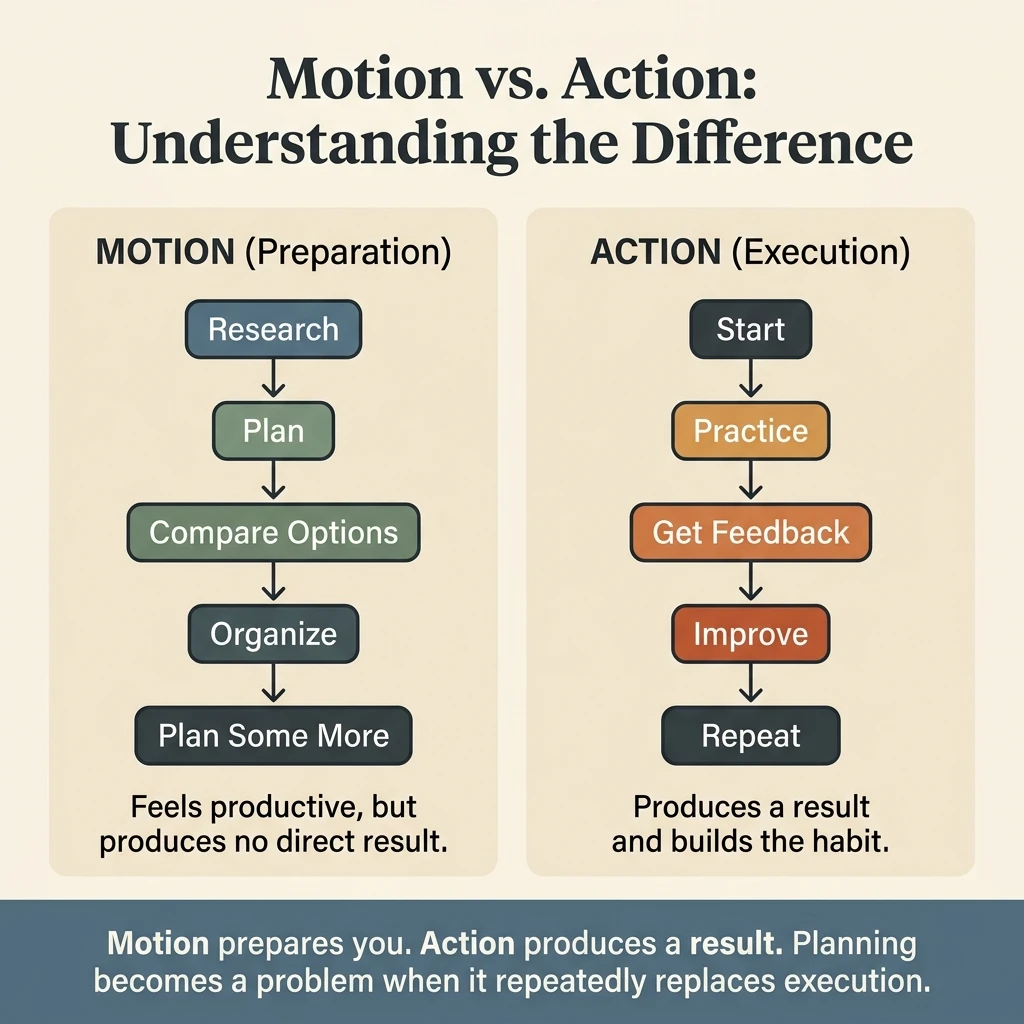
Motion prepares you. Action produces a result. Planning becomes a problem when it repeatedly replaces execution.
As shown above, motion consists of preparation steps (researching, planning, comparing options) that feel productive but produce no direct outcome on their own. Action consists of actual execution (starting, practicing, receiving feedback, and repeating) which creates real progress.
Planning has genuine value for preparation. However, when you find yourself continuously planning without executing, you are using motion as a buffer against starting.
What Is Motion?
Motion is preparation that can feel productive without necessarily producing the result you want.
Examples of being in motion include:
- Researching the best workout routine or diet plan
- Outlining 10 articles and organizing Notion workspace pages
- Comparing camera gear or software tools for hours
- Watching tutorials on how to learn a language
Motion is not inherently bad. It becomes a problem when it allows someone to postpone the actual behavior indefinitely while convincing themselves they are making progress.
What Is Action?
Action is the behavior that actually moves a task forward or produces an outcome.
| Motion (Preparation) | Action (Execution) |
|---|---|
| Researching writing techniques | Writing 300 words |
| Comparing gym memberships | Completing a 15-minute workout |
| Watching cooking videos | Cooking a healthy meal |
| Designing a study timetable | Solving 5 practice questions |
Why We Get Stuck in Motion
Motion can feel safer than action because it creates a sense of accomplishment without exposing you to the uncertainty of real execution.
Publishing an article creates the possibility of criticism. Researching article outlines does not. Starting a workout creates the possibility of physical discomfort or failure. Buying another fitness guide does not. This is why motion is often disguised procrastination—an emotional avoidance tactic (see our guide on How to Stop Procrastination Habits and the Two-Minute Rule for immediate behavioral interventions).
The Photography Experiment: Quantity vs. Quality
To illustrate why practice beats perfectionism, Clear references an experiment conducted by Professor Jerry Uelsmann at the University of Florida.
Uelsmann divided his film photography students into two groups:
- The "Quantity" Group: Graded strictly on the volume of work produced. 100 photos earned an A, 90 photos a B, 80 photos a C.
- The "Quality" Group: Graded solely on one single, perfect photograph.
At the end of the term, a surprising result emerged: the best photos were all produced by the quantity group.
Why Quantity Led to Better Quality:
• The quantity group spent the term taking photos, experimenting with lighting, testing composition, and learning from immediate mistakes.
• The quality group spent the term sitting around speculating about perfection, resulting in unverified theories and mediocre photos.
Lesson: Repeated practice creates more opportunities for feedback and learning than waiting until you know how to do something perfectly.
Why Repetition Matters More Than Perfect Timing
When people ask, "How long does it take to build a habit?" they are often asking the wrong question. What matters most is not calendar time, but repetition.
Every repetition of a behavior reduces hesitation and makes the action more familiar. Instead of asking:
❌ "How many days will this habit take to stick?"
✅ "How many repetitions have I actually accumulated so far?"
Frequency and Repetition: What Chapter 11 Is Really Emphasizing
Calendar time alone does not tell you how much practice someone has actually accumulated.
Consider two people learning a skill:
- Person A: Practices 10 minutes, 5 days per week (20 repetitions per month).
- Person B: Practices 2 hours, once every two weeks (2 repetitions per month).
Person A gets ten times more opportunities to initiate the habit, receive feedback, and reinforce the behavioral loop.
When Planning Is Actually Necessary
Chapter 11 does not suggest that all planning is useless. Planning is essential when:
- Safety or health is involved
- Mistakes carry severe financial or legal consequences
- Complex systems require architectural design before building
The key insight of Chapter 11 is not to abandon planning, but to ensure that planning serves as preparation for action—rather than a permanent substitute for it.
How to Turn Motion Into Action
Use this 5-step process whenever you catch yourself stuck in planning mode:
- Step 1 — Identify the Motion: Ask: "What am I doing right now that feels productive but produces no result?"
- Step 2 — Define One Action: Ask: "What is the smallest behavior that produces a real outcome?"
- Step 3 — Do One Rep Today: Execute that single action immediately.
- Step 4 — Learn From Feedback: Observe what worked and what didn't from actual execution.
- Step 5 — Repeat: Schedule your next repetition without waiting for perfection.
Real-Life Scenarios Across 5 Domains
1. Writing a Blog Post
Scenario: Someone wants to start writing online but spends days comparing website themes, reading about SEO, and organizing Notion workspace pages.
Motion: More research, theme customization, and outline preparation.
Action: Write and publish the first 300-word article.
Why It Matters: Publishing creates real reader feedback. The writer learns from execution rather than predicting what might work.
2. Starting an Exercise Routine
Scenario: Someone spends a week researching workout routines, watching fitness podcasts, and buying workout gear.
Motion: Comparing workout programs.
Action: Complete a simple 15-minute bodyweight workout today.
Why It Matters: Doing the workout provides immediate physical feedback and starts building the habit of showing up.
3. Learning a Language
Scenario: Someone downloads four language learning apps and watches YouTube videos about grammar rules.
Motion: Passive consumption of grammar rules.
Action: Speak or write 5 sentences aloud in the language today.
Why It Matters: Speaking reveals pronunciation and recall gaps that passive study cannot uncover.
4. Studying for an Exam
Scenario: A student spends three hours color-coding a study schedule but keeps postponing actual studying.
Motion: Designing timetables.
Action: Solve 5 practice exam questions.
Why It Matters: Practice questions test actual recall and highlight weak areas accurately.
5. Building a Daily Walking Habit
Scenario: Someone wants to walk every morning but spends days researching fitness trackers and optimal routes.
Motion: Gear and route research.
Action: Put on shoes and walk outside for 10 minutes.
Why It Matters: The habit begins through repetition, not through having perfect equipment.
Common Motion vs. Action Mistakes
- Endless Research: Continuing to consume information after knowing enough to take the first step.
- Buying Tools Instead of Practicing: Believing that purchasing new gear equals actual progress.
- Waiting for the Perfect Plan: Attempting to eliminate all uncertainty before taking action.
- Confusing Intensity With Consistency: Doing one huge session occasionally rather than small repeated reps.
- Measuring Only Final Results: Ignoring the value of accumulated repetitions and learning reps.
How to Apply Chapter 11 Today
- Step 1 — Choose One Goal: Pick a project or habit you have been postponing.
- Step 2 — Identify Your Motion: List what research or planning steps you have been doing instead of executing.
- Step 3 — Define One Action: Write down the smallest behavior that produces a real result.
- Step 4 — Do One Rep Today: Execute that single action immediately.
- Step 5 — Record What You Learned: Write down one insight gained from execution.
- Step 6 — Repeat: Schedule your next repetition.
Motion vs. Action Quick Table
| Motion (Preparation) | Action (Execution) |
|---|---|
| Researching workout plans | Completing today's workout |
| Watching writing tutorials | Writing 300 words |
| Designing a study schedule | Solving practice questions |
| Comparing language apps | Speaking five sentences |
| Organizing project notes | Completing one project task |
Need a quick reference?
Get the entire Atomic Habits system condensed into a fast, actionable guide.
Frequently Asked Questions
Q: What is Chapter 11 of Atomic Habits about?
A: Chapter 11 explains the difference between being in motion and taking action. Motion includes planning, researching, and preparing, while action is the execution that delivers a real outcome.
Q: What is the difference between motion and action in Atomic Habits?
A: Motion is preparation (such as researching workout routines or outlining a book) that feels productive but produces no result on its own. Action is performing the actual behavior (doing the workout or writing the page).
Q: Is planning bad according to Atomic Habits?
A: No. Planning is useful for preparation and strategy. However, planning becomes a problem when it is repeatedly used to delay or substitute for execution.
Q: What does the photography experiment in Chapter 11 teach?
A: Jerry Uelsmann’s photography experiment showed that students evaluated on quantity produced higher quality work than those focused only on one perfect shot, because taking many photos allowed repeated practice and learning through feedback.
Q: Why does repetition matter more than time for habits?
A: Habits form through repeated execution, not just calendar duration. The number of times you perform a behavior determines how familiar and automatic it becomes.
Q: How can I stop planning and start taking action?
A: Identify the smallest action that produces an outcome, perform one repetition today, learn from the feedback, and repeat the behavior regularly.
Previous Chapter
← Chapter 10: Find and Fix Causes of Bad Habits
Read Next
Chapter 12: Law of Least Effort →
Recommended Reading & Next Steps
Explore related chapter breakdowns, interactive tools, and practical guides:
Identity-Based Habits & Identity Circle
Learn how identity shapes habits, the 3 layers of behavior change, and how actions cast votes.
Atomic Habits for Athletes: Marginal Gains
How competitive athletes apply British Cycling systems, pre-game anchors, and recovery loops.
Why Atomic Habits Doesn’t Work for Some People
A critical analysis of willpower limitations, ADHD hurdles, and systemic habit failure.