
The Goldilocks Rule: Meaning, Motivation & Real Examples (Atomic Habits Chapter 19)
How to sustain long-term motivation, prevent burnout, and master the art of falling in love with boredom through just-manageable difficulty.
What Is the Goldilocks Rule?
In Atomic Habits, James Clear defines the Goldilocks Rule: “The Goldilocks Rule states that humans experience peak motivation when working on tasks that are right on the edge of their current abilities. Not too hard. Not too easy. Just right.”
When a task is too easy, we experience apathy and boredom. When a task is too difficult, we experience frustration, anxiety, and task avoidance. Peak engagement, dopamine release, and flow state occur in the Goldilocks Zone—working on challenges of just-manageable difficulty (roughly ~4% beyond your current baseline ability).
The Core Truth About Mastery
The greatest threat to success is not failure—it is boredom. Professionals stick to the schedule even when the work feels repetitive; amateurs let mood dictate consistency.
Chapter 19 in Simple Words: The 3 Zones of Challenge
To understand the Goldilocks Rule, imagine playing a competitive game of tennis or chess:
- Too Easy (The Boredom Zone): Playing against a complete beginner or a toddler. You win every point effortlessly, but within 10 minutes you lose interest and look at your watch.
- Too Hard (The Frustration Zone): Playing against a grandmaster or Olympic gold medalist. You lose every single point without understanding what happened, leading to helplessness and quitting.
- Just Right (The Goldilocks Zone): Playing against someone who is exactly at your skill level or slightly better. Winning requires 100% focus and effort, but success is realistic. You enter deep concentration.
Steve Martin and the 30-Year Comedy Progression
Clear introduces Chapter 19 with the career of legendary comedian Steve Martin.
Martin spent 10 years learning comedy, 10 years refining his material, and 10 years as the most successful stand-up comedian in the world. His success was not an overnight viral stroke of luck; it was a disciplined 30-year climb up the Goldilocks curve.
He began by performing 5-minute magic tricks at Disneyland for small crowds. As his confidence grew, he expanded to 10-minute routines, added original jokes, performed in clubs, and eventually sold out arenas. He stayed motivated across three decades because he constantly calibrated the difficulty of his act: always difficult enough to demand growth, but never so overwhelming that it broke his momentum.
The Goldilocks Difficulty Dial
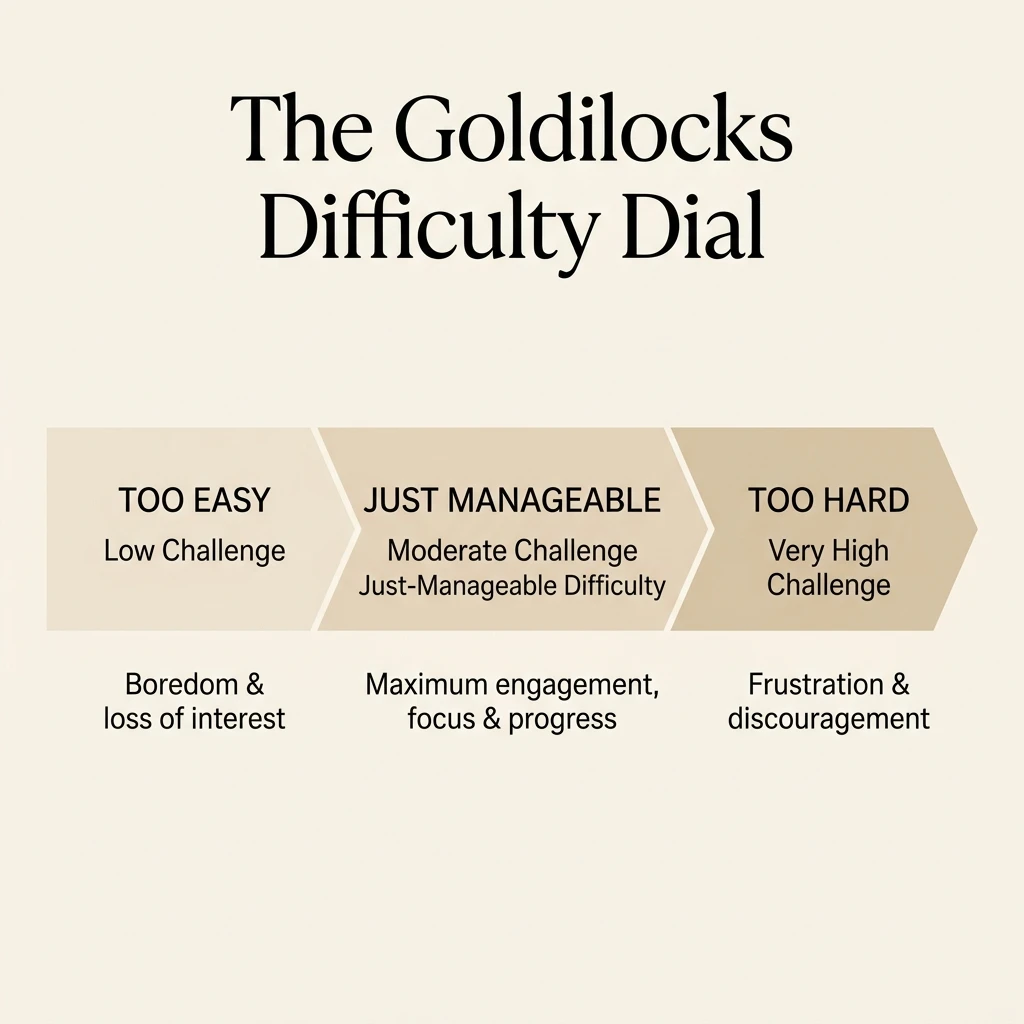
Peak human motivation occurs when task difficulty matches expanding human capacity.
Why Good Habits Become Boring (And Why That Is Dangerous)
When you first start a new workout plan, language app, or morning routine, the experience is exciting. You learn new techniques, notice rapid beginner gains, and receive constant dopamine rewards.
However, once the routine becomes automated, the novelty evaporates. Doing your 50th workout or writing your 100th journal entry feels ordinary.
This is where most people fail. They confuse boredom with ineffectiveness. Assuming that the routine is broken, they abandon their working habit to chase a novel new workout program or diet trend. In reality, boredom is evidence that the habit has successfully become automatic.
Professionals vs. Amateurs: The Habit Mindset
Clear writes one of the most quoted passages in modern personal development:
“The greatest threat to success is not failure but boredom. We get bored with habits because they stop delighting us. The outcome becomes expected. And as our habits become ordinary, we start derailing our progress to seek novelty.”
James Clear emphasizes that professionals stick to the schedule. Amateurs let mood, weather, fatigue, or boredom decide whether they show up.
Elite athletes and top authors get bored just as frequently as anyone else. The difference is that they have developed the mental resilience to execute high-quality work regardless of whether they feel inspired.
Gradual Challenge Progression
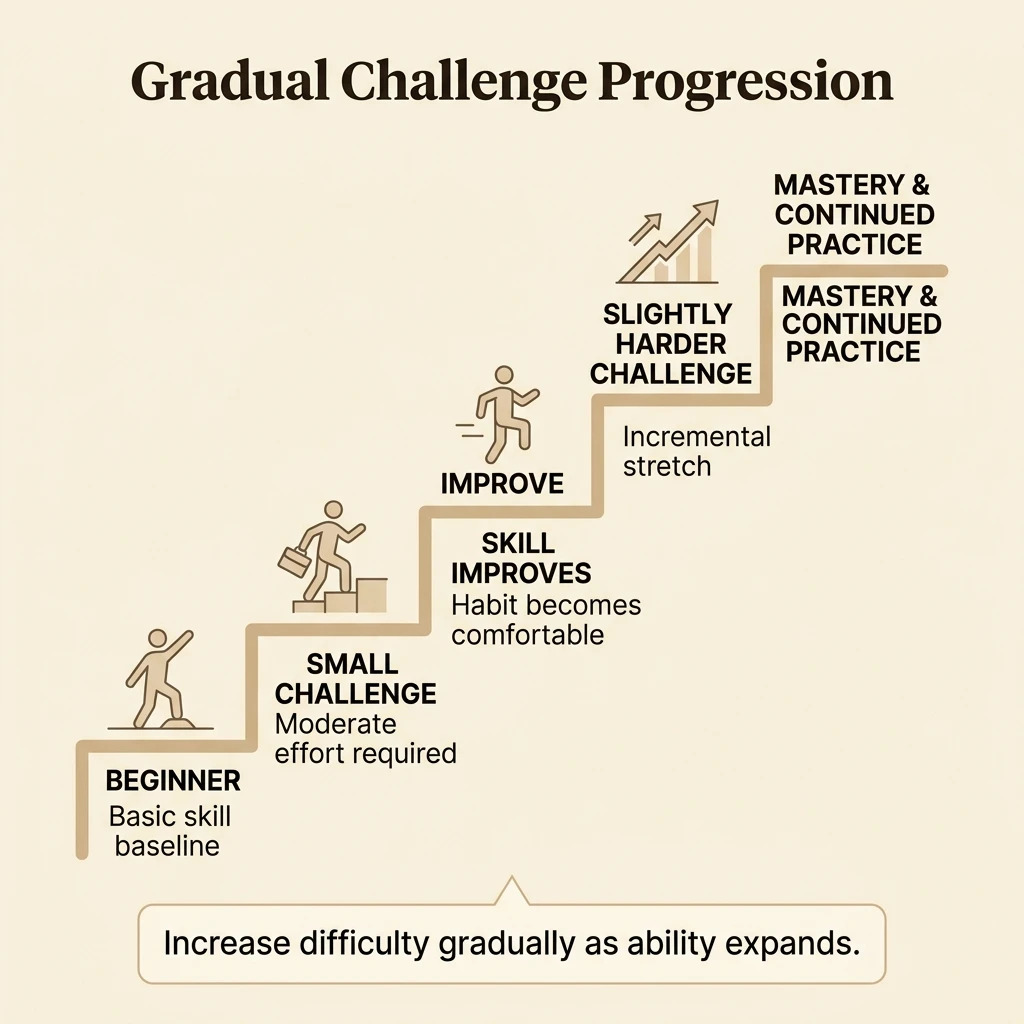
Increase difficulty gradually as ability expands to maintain engagement over time.
How the Goldilocks Rule Connects to Flow State
Psychologist Mihaly Csikszentmihalyi coined the term Flow to describe the mental state of complete absorption in an activity.
The Goldilocks Rule is the practical formula for entering flow: when a task requires roughly 100% of your current cognitive capacity without exceeding it, your brain filters out distractions, self-consciousness vanishes, and you experience deep work immersion.
How to Adjust Difficulty as You Improve (The 4% Rule)
Clear references behavioral research suggesting that increasing difficulty by approximately 4% beyond your current comfort level is the ideal threshold to maintain motivation without triggering anxiety.
- In Fitness: If you can comfortably bench press 150 lbs for 5 reps, add 2.5–5 lbs (a ~3–4% increase), rather than attempting 180 lbs.
- In Writing: If you easily write 500 words in 30 minutes, challenge yourself to write 525 words with tighter arguments.
- In Language Learning: If you know 200 vocabulary words, add 8 new words each week rather than trying to memorize 50 words in one night.
Real-Life Scenarios Across 4 Domains
1. Workplace & Professional Coding / Design
Too Easy: Fixing simple text typos in existing codebases (boredom).
Goldilocks Zone: Architecting a new API endpoint using a familiar framework with one novel caching layer.
Too Hard: Rebuilding the entire backend in an unfamiliar programming language in 24 hours.
2. Language Acquisition
Too Easy: Reviewing basic “Hello / Goodbye” flashcards you mastered months ago.
Goldilocks Zone: Listening to a native podcast spoken at 0.9x speed with transcripts.
Too Hard: Reading 19th-century classical literature without a dictionary.
3. Athletic Training
Too Easy: Jogging 1 mile at a walking pace with zero elevated heart rate.
Goldilocks Zone: Running a 5K interval session where the final 400m requires grit.
Too Hard: Attempting a 20-mile marathon trail run on zero training.
Goldilocks Challenge Calibrator
Evaluate whether your current task is likely too easy, in a manageable challenge range, or too difficult.
Need a quick reference?
Get the entire Atomic Habits system condensed into a fast, actionable guide.
Frequently Asked Questions
Q: What is the Goldilocks Rule in Atomic Habits?
A: The Goldilocks Rule in Atomic Habits states that human motivation peaks when working on tasks of just-manageable difficulty—roughly 4% beyond your current ability. Tasks that are too easy lead to boredom, while tasks that are too hard cause anxiety and burnout.
Q: What is the meaning of the Goldilocks Rule?
A: Named after the fairy tale "Goldilocks and the Three Bears," the rule means finding the "sweet spot" of difficulty: not too easy, not too hard, but just right. This calibrated challenge keeps dopamine engagement high and sustains consistent habit practice.
Q: Why is boredom the greatest threat to success in Atomic Habits?
A: James Clear notes: "The greatest threat to success is not failure but boredom." When habits become automated, the novelty wears off. People quit or switch routines not because the habit failed, but because they lost interest. Top performers succeed because they learn to show up even when work feels routine.
Q: What is the difference between professionals and amateurs in Atomic Habits?
A: James Clear explains that professionals stick to the schedule regardless of mood or boredom, whereas amateurs let their daily feelings, mood swings, and lack of motivation dictate whether they show up.
Q: How does the Goldilocks Rule connect to Flow State?
A: The Goldilocks Rule directly mirrors psychologist Mihaly Csikszentmihalyi’s Flow model: when task difficulty precisely matches your advancing skill level, you enter a state of effortless concentration where time seems to disappear.
Recommended Reading & Next Steps
Explore related chapter breakdowns, interactive tools, and practical guides:
Identity-Based Habits & Identity Circle
Learn how identity shapes habits, the 3 layers of behavior change, and how actions cast votes.
Atomic Habits for Athletes: Marginal Gains
How competitive athletes apply British Cycling systems, pre-game anchors, and recovery loops.
Why Atomic Habits Doesn’t Work for Some People
A critical analysis of willpower limitations, ADHD hurdles, and systemic habit failure.